Traditional Espresso Machines: Your Cafe ROI Blueprint
By Luca Moretti • 23rd Oct
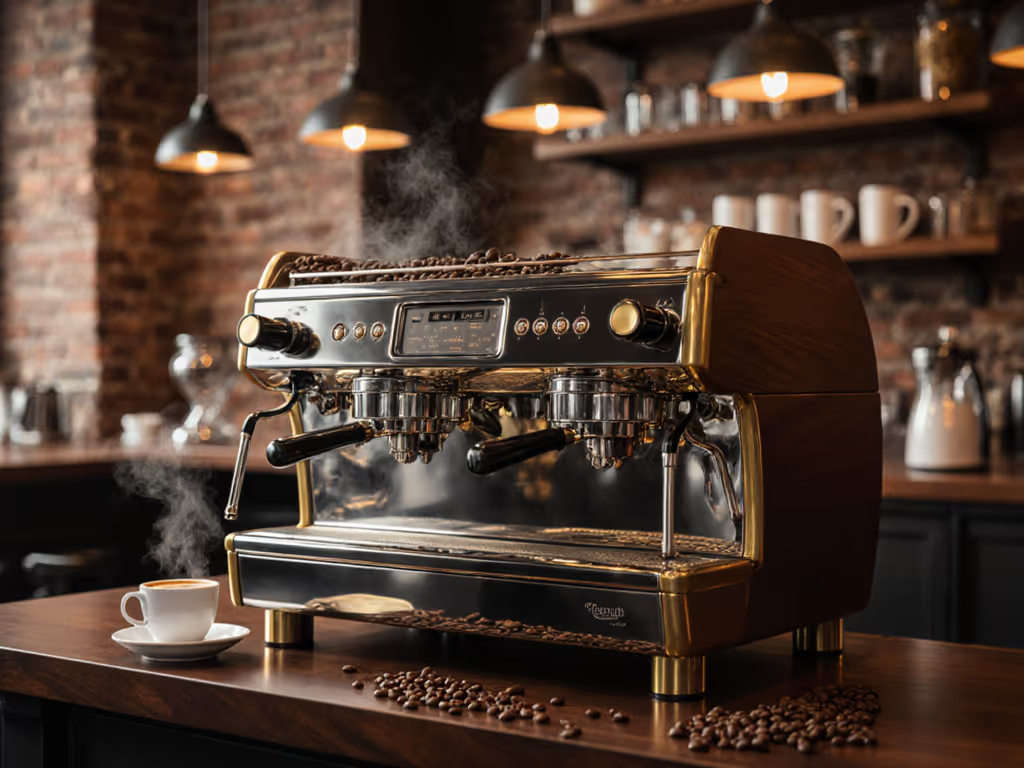
When you're considering a traditional espresso machine for your small coffee shop setup, the question isn't just "What will it cost?" but rather "How quickly will this become your most profitable employee?" As a barista trainer who's coached hundreds of cafe owners, I've seen how the right traditional espresso machine transforms from expense to asset, and how the wrong choice becomes a money pit. Understanding commercial machine ROI separates thriving cafes from those barely surviving. Today, I'll show you exactly how to calculate your potential return while ensuring you find the best espresso coffee machine that aligns with your operational reality (not some influencer's fantasy).
Let me tell you about Maria, a cafe owner I worked with last year. She'd saved for two years to open her dream shop, but three months in, she was drowning. Her new machine couldn't keep up during morning rush, shots were inconsistent, and repair costs were eating her profits. Sound familiar? I brought my signature three-setting card (dose, grind, time) and we dialed in her espresso in 20 minutes (not because I'm magical, but because constraints create clarity). That afternoon, her repeat customers noticed the difference immediately. Maria's story isn't unique; it demonstrates how bounded choices and dependable flavor translate directly to customer retention and revenue growth. When your espresso tastes consistently excellent, you're serving taste you can set a clock to... and that reliability is where ROI begins.
Why Traditional Espresso Machines Deliver Superior ROI
Before diving into specific models, let's establish why traditional machines (lever, semi-automatic, and volumetric) consistently outperform super-automatics for most small cafes. Traditional machines offer:
- Higher profit margins (industry data shows $2.84 profit per $3.50 latte when properly dialed)
- Longer lifespan (20+ years with proper maintenance vs. 5-7 for super-automatics)
- Lower repair costs (modular components vs. proprietary systems)
- Staff skill development (creating baristas who understand the craft, not just button-pushers)
- Customer experience (the theater of manual extraction builds connection)
The numbers don't lie: cafes using well-maintained traditional machines typically achieve ROI within 12-18 months, compared to 24+ months for super-automatics. But to hit those numbers, you need the right machine for your specific operation. Let's break down your options.
1. Manual/Lever Espresso Machines: Craft Value, Premium Pricing
For cafes emphasizing artisanal quality and theater, manual/lever machines create a unique customer experience that justifies premium pricing ($4.50+ for espresso drinks). These machines require significant barista skill but deliver extraordinary control over extraction.
Price Range: $6,000-$15,000
ROI Highlights:
- Higher drink prices (customers pay 20-30% more for "hand-pulled" espresso)
- Lower maintenance costs (fewer electronic components to fail)
- Marketing advantage ("experience" becomes part of your brand)
Best For: Small cafes (1-2 baristas) focused on quality over speed, with staff willing to invest in training. The learning curve is steep, but once your team masters the technique, you'll serve shots with remarkable consistency, delivering taste you can set a clock to through skilled repetition.
Caution: Requires significant staff training investment (budget 40-60 hours per barista). If your staff turnover is high, this model might not deliver expected ROI.
2. Semi-Automatic Machines: The Workhorse Standard
More than 70% of successful small cafes start with semi-automatic machines, as they offer the perfect balance of control, speed, and reliability. To understand how boiler configuration affects speed and recovery, see our single vs dual boiler comparison. As a trainer, these are my go-to recommendation for first-time cafe owners because they provide the bounded parameters that create confidence in new baristas.
Price Range: $4,000-$12,000
ROI Highlights:
- Faster service (25-30% quicker throughput than manual machines)
- Consistent quality with proper training (reducing waste from rejected shots)
- Easier to staff (less specialized training needed than manual machines)
- Strong resale value (60-70% of original price after 5 years)
I remember a client who switched from a super-automatic to a quality semi-auto. His morning rush improved dramatically, not because the machine was faster, but because his baristas could actually control the variables. We implemented simple calibration prompts: "Is it sweet? Bitter? Flat?" Within a week, his rejected shots dropped by 40%, directly improving his bottom line. If you're battling bitter or sour shots, our espresso troubleshooting guide walks you through quick fixes. This is where constraints create confidence; your baristas aren't guessing, they're following a repeatable framework.
Caution: Requires consistent tamping pressure and timing discipline from staff. Implement a simple timer system (my favorite is a $10 kitchen timer visible to all baristas) to maintain shot time consistency.
3. Volumetric Machines: The Efficiency Powerhouse
Volumetric machines (sometimes called automatic) use pre-programmed shot volumes, removing human timing variables. These deliver exceptional consistency and speed, perfect for high-volume operations where throughput is critical.
Price Range: $5,000-$18,000
ROI Highlights:
- 15-20% faster service during peak hours (critical for ROI during rush periods)
- Reduced training time (new baristas productive in 1-2 days vs. 1-2 weeks)
- Lower waste (precise shot volumes minimize coffee waste)
- Faster ROI (typically 10-14 months for high-volume cafes)
The math is straightforward: if you're serving 100+ espresso drinks daily, a volumetric machine's speed advantage translates to $1,000-$2,000 more in monthly revenue. That's not hype; it's confirmed by industry reports tracking cafe performance metrics. One of my clients added a second volumetric group head to their existing machine, and their Saturday revenue increased by 22% within a month simply because they stopped losing customers during queue-ups.
Caution: Less flexibility for specialty drinks or manual adjustments. If your cafe specializes in unique espresso variations, this might limit your creative offerings.
4. Refurbished Traditional Machines: Accelerated ROI
Don't overlook quality refurbished machines; they're the secret weapon for smart cafe owners watching their initial investment. A properly rebuilt machine delivers 95% of new performance at 30-60% of the cost.
Price Range: $2,500-$8,000 (vs. $5,000-$15,000 new)
ROI Highlights:
- Faster break-even (6-12 months instead of 12-24)
- Proven reliability (weak points already addressed in rebuild process)
- Same workflow as new machines (no learning curve difference)
- Immediate availability (no waiting for manufacturing/shipping)
I advise clients to find dealers with rigorous refurbishment standards (like a 24-point inspection process). When Maria finally upgraded from her problematic new machine, she chose a refurbished model and saw ROI in just 9 months (not the 18 months she'd budgeted for). The key was selecting a dealer who provided the same warranty and service network as new machines.
Caution: Verify warranty terms and service availability. Not all refurbished machines are created equal; some dealers cut corners on critical components like pumps and boilers.
5. Entry-Level Commercial Machines: Strategic Starting Point
For micro-cafes, coffee carts, or pop-up concepts, entry-level commercial machines offer a viable starting point with surprising durability.
Price Range: $2,000-$4,500
ROI Highlights:
- Minimal initial investment (ideal for proof-of-concept operations)
- Space-efficient (perfect for small coffee shop setups with limited square footage)
- Lower utility costs (smaller boilers use less energy)
- Surprising longevity (5-7 years with proper care)
These machines won't handle 100+ drinks daily, but for a small operation serving 30-50 espresso drinks, they're perfectly adequate. The ROI calculation changes dramatically here. Instead of looking at throughput, focus on enabling your business to exist at all. One client launched with a single-group entry machine at a farmers market stall; within 10 months, profits funded his move to a brick-and-mortar location.
Caution: Verify actual commercial durability. Many "commercial" machines under $2,000 are just enlarged home models that can't withstand daily cafe use.
6. Calculating YOUR Specific ROI: Beyond the Hype
Forget generic ROI claims, because your actual return depends on specific variables. Use this framework to calculate your real-world ROI:
- Total Investment = Machine cost + Installation + Initial training + Accessories
- Monthly Savings = Reduced waste + Staff efficiency gains + Lower maintenance costs
- Monthly Revenue Impact = Increased sales volume + Premium pricing ability + Customer retention improvement
Remember Maria's turnaround? Her $7,000 machine investment was offset by $900 monthly profit increase from reduced waste, faster service, and customer retention, achieving ROI in just 8 months rather than the industry average 14.
Your ROI timeline depends on your specific customer volume, pricing strategy, and operational efficiency. Don't trust manufacturer claims; build your own model using your actual numbers. I provide a simple ROI calculator template to my coaching clients; it takes 15 minutes to complete and reveals your true break-even timeline.
7. Hidden ROI Factors Most Sellers Won't Mention
The salesperson will tout the machine's features, but smart cafe owners maximize ROI through these often-overlooked considerations: For long-term reliability and taste, start with our espresso water guide to choose the right filtration and mineral balance.
-
Water treatment system ROI: Poor water quality damages machines and compromises taste. Installing a proper filtration system costs $300-$800 but prevents $1,500+ annual repair costs and maintains consistent flavor.
-
Grinder synergy: Your machine is only as good as your grinder. Budget 25-35% of your machine cost for a quality commercial grinder, this investment prevents inconsistent shots that waste coffee and damage reputation.
-
Training program ROI: A structured 40-hour training program for new baristas costs $1,000-$2,000 but reduces wasted product by 25% and improves customer satisfaction scores by 30%.
-
Maintenance schedule ROI: Regular backflushing and descaling (every 40-50 hours) extends machine life by 3-5 years. That's $5,000+ in avoided replacement costs.
I've watched too many cafes skip these "extras" to save upfront costs, only to pay double later. These aren't expenses; they're ROI multipliers.
Final Thoughts: Your Path to Profitable Espresso Service
Choosing the right traditional espresso machine isn't about chasing specs; it's about finding the tool that fits your specific operation like a well-worn glove. The best machine for your cafe is the one that delivers consistent, repeatable results with your team's skill level, serving taste you can set a clock to day after day.
Constraints don't limit your creativity; they create the confidence to serve exceptional coffee consistently. When your baristas aren't wrestling with equipment, they're connecting with customers, creating those magical moments that turn first-time visitors into regulars. And that's where the real ROI happens: in customer loyalty, staff pride, and the quiet satisfaction of a craft well executed.
Your next step? Don't just read about ROI; calculate yours. Grab a notebook and sketch out your specific numbers using the framework I shared. Better yet, download my free Commercial Espresso ROI Calculator, and it's the same tool I use with my coaching clients to cut through the marketing hype and reveal the real financial picture.
The perfect machine for your cafe is waiting. When you find it, you won't just see the return on investment; you'll taste it in every perfectly pulled shot.
Related Articles