Appia II Compact Review: Commercial Power, Real Costs
By Daniel Ortiz • 7th Mar
The Appia II compact review landscape shows a pattern I've tracked for years: buyers choose based on shiny specs, then spend the next 24 months discovering what the spreadsheet didn't say. The Appia II compact and its newer sibling, the Appia Life compact, promise commercial-grade espresso in a footprint that actually fits a cafe, restaurant kitchen, or mobile cart. But "commercial" doesn't equal worry-free. Compact design, energy claims, and warranty language can mask weak points in parts availability, repair access, and true cost-per-shot math that separates keepers from regrets.
I've spent enough time cross-referencing invoices and parts diagrams to know: the machine that looks like the bargain often becomes the tax on your time. This review strips away the marketing and builds a lifecycle model for anyone genuinely trying to decide whether a compact commercial machine fits their setup and budget, and whether they'll still feel that way two years in.
The Problem: Compact Commercial Machines Demand Trade-Offs You Can't See Upfront
You're caught between two truths. On one side, a compact 2-group machine can deliver cafe-quality shots and steam two milk drinks in succession without the thermal lag that plagues cheaper single-boiler models. On the other, compact doesn't mean trouble-free. Tighter mechanical tolerances, modular builds squeezed into 22" × 22" footprints, and OEM parts lists that don't always overlap with aftermarket suppliers create a hidden cost penalty once the machine settles into your workflow.
The Appia II compact and Nuova Simonelli line promise energy savings and compact dimensions, but the real question isn't whether they make good espresso, they do. It's whether you'll face 3-week parts delays, whether a gasket failure costs $15 or $150, and whether the warranty covers what actually breaks under daily load. Most reviews skip this math entirely, leaving you to learn it the expensive way.
Understanding the Appia Line: Evolution, Not Revolution
From Appia II to Appia Life: Specification Shifts
The Appia II compact set a baseline: 24" width, 27" height, 150 lbs, dual 2-group design with manual and automatic control options. It delivered consistent shots and reliable steaming, earning a reputation for durability in small commercial spaces.
The newer Appia Life compact, released as an efficiency refresh, narrows the footprint to 22" × 22" × 21" and lightens the load to around 130 lbs. That 2-inch width reduction matters more than it sounds in tight kitchens. The trade-off: it operates at slightly lower wattage in some configurations (1500W on 110V vs. 2900W on 220V), though the thermal mass remains competitive, a 7.5-liter boiler paired with a heat exchanger design.
Cost-per-shot tells the truth, and the truth here is that the smaller, lighter chassis still uses about 13% less energy per shot than the Appia II.
Energy Claims and Reality
Nuova Simonelli markets the Appia Life with a 13% energy reduction versus the Appia II, achieved through improved thermal insulation (DRYTEX technology) and refined boiler geometry. Over 12 months of daily operation, that translates to roughly $180-$280 in reduced electricity, depending on local rates and shot volume. For a deeper look at electricity usage across boiler types, see our espresso machine energy cost guide.
However, energy savings alone don't justify an upgrade. The real question: Does the new machine reduce parts failures, extend service intervals, or lower repair costs? Public materials rarely surface that data, which is itself a red flag. Marketing teams happily publish energy benchmarks but rarely publish warranty claim rates or average time-to-repair.
Appia Life Models: A Compact Lineup with Distinct Costs
The Compact (2-Group) Tier
The Appia Life compact comes in three operational flavors: volumetric (pre-programmed shot volumes), semi-automatic (manual control), and a newer XT variant with a larger boiler. For most commercial settings, the volumetric model dominates because it reduces barista decision-making and improves consistency across shifts.
Specifications:
- Dimensions: 22" W × 22" D × 21" H
- Boiler: 7.5L (standard), 11L (XT)
- Power: 2900W (220V); 1500W (110V)
- Weight: ~130 lbs
- Certifications: UL, NSF/ANSI Std. 4
- Warranty: 1-year labor, 2-year parts, lifetime on boiler
The volumetric version supports up to 4 pre-set shot volumes per group. A barista taps a button; the machine doses and stops automatically. For operations running 100+ drinks per day, that's a friction-reducer. For home prosumers pushing 20-30 drinks weekly, it's overkill; semi-automatic remains cheaper and more pedagogically valuable.
Productivity claim: The Appia Life compact can execute 250 cappuccinos per day (2-group standard). In real terms, that's 125 drinks per group, or one drink every 4.8 minutes per group. Feasible, but only if your grinder keeps pace and your milk steaming doesn't create bottlenecks. The machine can deliver the espresso; your workflow speed matters as much.
The Standard (3-Group) and Extended Boiler Tiers
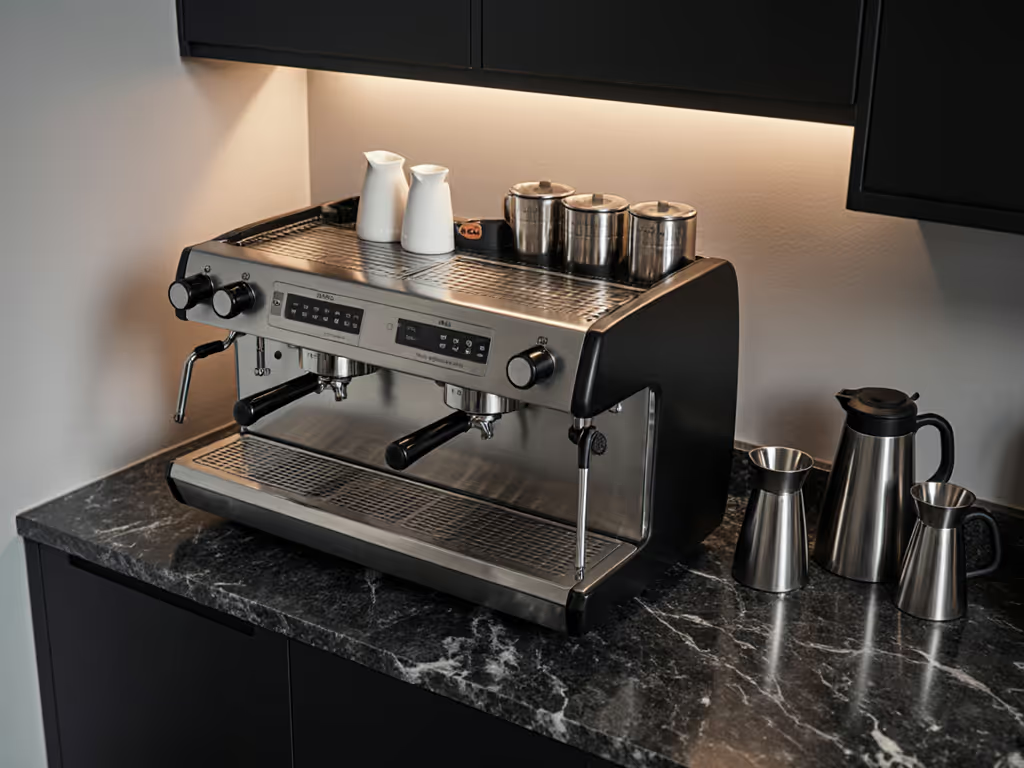
If your space allows, the 3-group configuration adds a third group and bumps the boiler to 15L, supporting higher throughput with less thermal stress between consecutive milk drinks. Dimensionally, you're looking at roughly 40" width, still mobile-cart friendly but pushing into dedicated-cafe territory.
Key difference: The larger boiler doesn't just store more hot water; it buffers steam demand more gracefully. Two cappuccinos back-to-back? A 7.5L boiler recovers quickly but feels the strain. A 15L boiler absorbs the load, reducing recovery lag and improving temperature stability during the second steaming cycle. For prosumers serving guests or running pop-ups, this matters more than the spec sheet suggests.
What the Warranty Actually Covers (and Doesn't)
The Appia Life compact includes a 1-year labor, 2-year parts, and lifetime boiler warranty. Sounds robust until you parse it:
- 1-year labor: Once month 13 rolls around, you're paying service calls out-of-pocket. A 2-hour technician visit (parts, travel, labor) typically runs $250-$450. If your solenoid valve fails at year 1.5, you're covering labor.
- 2-year parts: OEM gaskets, shower screens, and valves are covered in years 1-2. Beyond that, you're sourcing aftermarket spares. If the vendor relationship is thin, lead times spike and prices climb.
- Lifetime boiler: Boiler failure is rare in commercial machines, but when it happens, replacement or re-tubing runs $800-$1500 in parts alone. This coverage is valuable but covers the rarest failure mode.
The warranty doesn't cover normal wear items (gaskets, hoses) or misuse. Descaling neglect isn't covered. Neither are modifications. For a cafe or bakery, this is standard; for a home prosumer, it's restrictive. You can't "experiment" without voiding coverage. For details on what warranties really cover, see our espresso machine warranty guide.
Backflush and Service Access
Both Appia II and Appia Life designs include backflush-compatible groupheads (3-way solenoid valves), which means you can flush coffee grounds backward through the group to clear micro-channels without pulling the portafilter. Standard for commercial machines but critical for daily maintenance. Backflushing reduces group gasket fouling and extends service intervals.
The modular assembly design (typical for Nuova Simonelli) means grouphead removal takes about 10 minutes with basic tools. OEM grouphead replacement runs $200-$300; rebuild kits (gaskets, shower screen, dispersion plate) run $40-$80. This is actually accessible compared to proprietary designs, but only if spare parts stay in stock at your local supplier or online vendor.
Heat Exchanger vs. Dual Boiler: The Architecture Choice
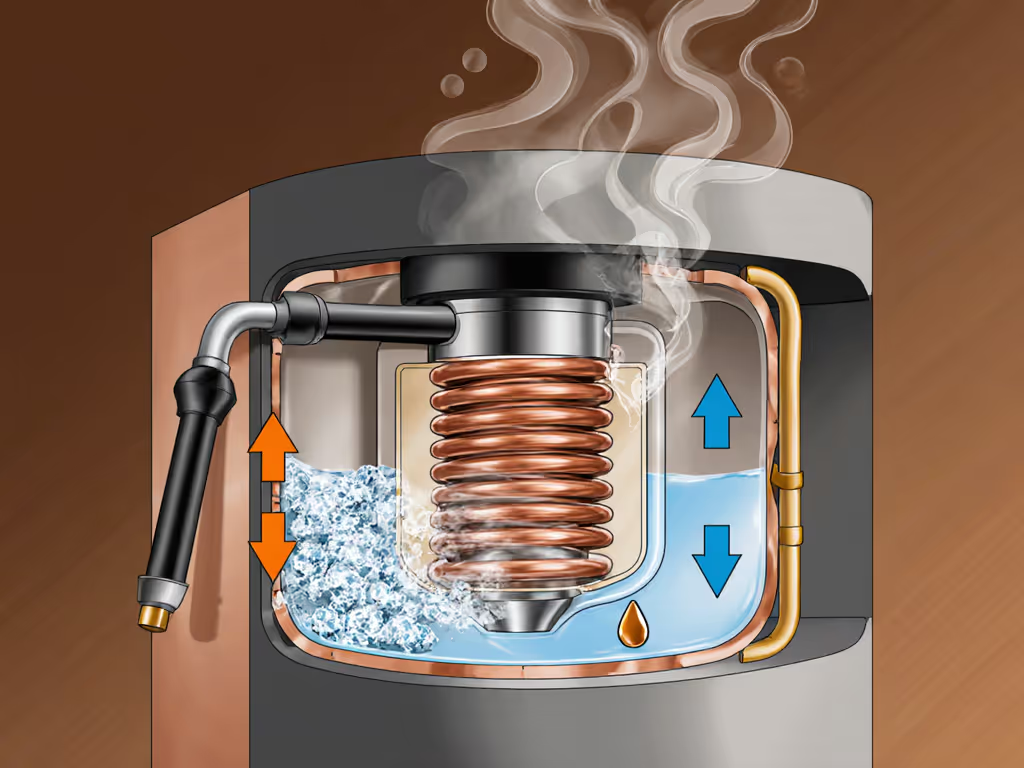
Both the Appia II and Appia Life compact use a single boiler with heat exchanger design, not dual boilers. If you need a refresher on HX vs dual boiler, read our technical comparison. This is worth understanding because it affects repair cost, complexity, and downtime risk.
Heat exchanger advantage: One boiler, one heating element, fewer failure points. Water for espresso and steam comes from the same boiler via an internal loop. The machine reaches brew-temperature espresso within 5-10 seconds of steam-mode operation. Complexity and cost are lower than dual-boiler designs.
Heat exchanger downside: If the heat exchanger develops scale buildup or a micro-leak, the entire unit must be descaled or replaced. You can't isolate the problem to one section. Descaling (via citric acid or commercial descaler) takes 45-90 minutes and requires operator skill. Mistakes damage the exchanger.
Dual-boiler machines segregate espresso and steam boilers; a failure in one doesn't compromise the other. But dual-boiler designs run hotter (higher electricity draw), weigh more, and cost 30-50% more upfront. For a compact machine prioritizing footprint and energy efficiency, heat exchanger logic wins, but only if you commit to disciplined descaling every 30-40 days (depending on water hardness).
Total Cost-of-Ownership Model: Year One Through Year Three
This is where the spreadsheet becomes real. Let's trace a Appia Life compact over 36 months in a light-commercial setting (cafe running ~300 drinks per week, ~15,000 drinks per year).
Year One
| Category | Cost | Notes |
|---|---|---|
| Machine (220V volumetric) | $3,200-$3,800 | Retail varies by distributor |
| Installation & setup | $300-$500 | Electrical, water connection, training |
| Water treatment (filters, resin) | $120 | Proper water lowers mineral stress |
| Descaling & chemical (6 cycles @ $15 each) | $90 | Citric acid or commercial descaler |
| Gasket/shower screen replacements | $80 | Preventive, year-1 use |
| Warranty coverage | $0 | Included |
| Year One Total | ~$3,790-$4,490 |
Year Two
| Category | Cost | Notes |
|---|---|---|
| Preventive maintenance (gaskets, O-rings) | $150 | More frequent wear |
| Descaling & chemical (6 cycles) | $90 | Ongoing |
| Parts warranty (if claim) | $0 | Still covered |
| Labor (if service needed) | $0-$250 | Warranty covers labor in year 2 |
| Unplanned repairs (misc.) | $0-$400 | Solenoid, hose, thermometer |
| Year Two Total | ~$240-$890 | Assume light service |
Year Three
| Category | Cost | Notes |
|---|---|---|
| Preventive maintenance | $200 | Seals wear faster with age |
| Descaling & chemical | $90 | Ongoing |
| Warranty coverage expires | - | Parts now out-of-pocket |
| Service labor | $250-$600 | No warranty coverage; pay per call |
| Parts (solenoid, gaskets, pump seal) | $150-$400 | Post-warranty sourcing |
| Year Three Total | ~$690-$1,390 | Warranty cliff is real |
Three-year total: $4,720-$6,770 in true ownership cost, or $0.31-$0.45 per shot (assuming 15,000 shots per year, 3 years). This doesn't include setup labor, grinder maintenance, espresso beans, or operator training, only the machine itself.
Compare to a budget single-boiler prosumer machine ($800 retail, but higher maintenance and downtime): cheaper upfront, but annual labor and parts costs spike faster after year one, erasing the upfront savings by year 2.5. The compact commercial machine wins on reliability and cycle longevity, but only if you actually use it enough to amortize the upfront cost.
Risk Flags and Mitigations
Parts Availability Outside Major Markets
Risk: Nuova Simonelli has strong North American and European distribution, but regional availability varies. If you're in a smaller city or rural area, OEM parts can take 2-4 weeks. Aftermarket suppliers stock common items, but exotic items or year-specific models may not.
Mitigation: Before purchase, contact local distributors and ask about their parts inventory and average lead times. Buy spare gaskets, shower screens, and a backflush disk (3-way solenoid wear item) at install. Maintain a $200 spare-parts reserve fund. It pays for itself the first time you avoid downtime.
Water Quality and Descaling Discipline
Risk: Heat exchangers are sensitive to mineral buildup. Hard water (>300 ppm TDS) degrades internal surfaces and reduces heat transfer efficiency. Neglecting descaling voids parts warranty and shortens component life.
Mitigation: Install a proper water softener or RO system. For chemistry-backed recommendations, read our best espresso water guide. Budget $10-$20 per month for filters and resin. Descale every 30 days (or per manufacturer schedule, whichever is more frequent). Document every descaling; keep receipts in case warranty claims arise.
Thermal Recovery and Milk Steaming Under Load
Risk: The 7.5L boiler (standard compact) can steam two 8-oz milk pitchers back-to-back without major lag, but successive drinks strain recovery. If your cafe runs a milk-heavy menu (cappuccinos, lattes, flat whites), the compact model may throttle throughput during peak hours.
Mitigation: Test-run the machine in your intended environment for a full week before committing. If you regularly serve 5+ milk drinks per hour, upgrade to the 3-group (15L boiler) or consider a dual-boiler alternative, accepting the larger footprint and higher energy cost.
Noise and Vibration
Risk: Commercial pump-driven machines generate 75-85 dB of noise during shot pulling and steaming, equivalent to busy city traffic. If noise is a constraint, compare options in our quiet espresso machine picks. In shared kitchens, studios, or open cafe layouts, this disrupts conversation and creates fatigue.
Mitigation: Isolate the machine on vibration-dampening mats (rubber pads, $30-$60). Position it away from seating areas if possible. Warn staff and guests on day one. If noise is a genuine issue, consider a super-automatic or home espresso machine (quieter, but lower quality).
Appia II Compact vs. Appia Life Compact: Upgrade Worthiness
If you already own an Appia II compact and are wondering whether to upgrade to Appia Life:
Upgrade if:
- Your kitchen space is tight and the 2-inch width reduction matters
- Your electricity bill is a line item (cafe, not home), and 13% savings is measurable
- Your Appia II is out of warranty and repairs are becoming frequent
- You want newer feature sets (Autosteam, improved volumetric programming)
Don't upgrade if:
- Your Appia II is still under warranty and performing well
- You're not energy-cost sensitive (home use)
- Your current throughput doesn't tax the machine
- Downtime during machine swap is unacceptable
For a side-by-side cost calculation: selling a 3-year-old Appia II for $1,500-$2,000 (used market), then buying a new Appia Life for $3,500 costs roughly $1,500-$2,000 net outlay. Over 3 years, that energy savings of ~$240 doesn't justify the gap. The upgrade math only pencils out if you're in a high-throughput commercial setting or if the Appia II requires expensive repairs.
Prosumer Expectations vs. Commercial Reality
A common mistake: home enthusiasts or pop-up vendors buy commercial machines expecting "prosumer" prices and "home" maintenance ease. Commercial machines assume:
- Daily use, not occasional weekend tinkering
- Trained operators, not hobbyists learning by trial and error
- On-site service, not mail-in repairs
- Replacement mindset, not heirloom expectations
The Appia compact can work in a home or small pop-up setting, but you're paying a commercial price ($3,200+) for a machine optimized for cafe workflow. For hobby-grade quality at lower cost, single-boiler prosumer machines or heat-exchanger home models ($1,200-$2,000) may deliver better value and fewer maintenance headaches.
However, if you're genuinely running a business (catering, mobile cart, small cafe) and plan to rely on this machine 300+ days per year, the commercial build quality, warranty, and parts availability justify the premium. The trade-off is this: own the math, and the machine will never own you.
Final Verdict: Worth the Investment?
The Appia II compact and Appia Life compact are solidly engineered machines with a proven track record in tight commercial spaces. If your decision comes down to these two, the Appia Life edge is real but incremental, better thermal efficiency, slightly smaller footprint, refined controls. It's a refinement, not a revolution.
For a cafe or bakery running 400+ drinks per week: Yes. The compact footprint, dual steam wands, and reliable heat exchanger design earn their cost back over 3 years in durability and avoided downtime. Budget $3,500-$4,000 for the machine, add $500-$1,000 for water treatment and spare parts, and commit to disciplined maintenance. Your cost-per-shot will stabilize around $0.35-$0.40, competitive with larger single-location cafes.
For a pop-up, mobile cart, or small roastery running 150-300 drinks per week: Consider, but scrutinize. A commercial machine is overkill if utilization is inconsistent. A high-end prosumer heat-exchanger model may deliver 80% of the performance at 60% of the cost, with lower maintenance demands.
For home use or hobby-grade aspiration: Skip it. Unless you're obsessed with commercial-level consistency and have the space, electrical infrastructure, and ongoing maintenance discipline, a prosumer-grade machine ($1,500-$2,500) will feel less demanding and more forgiving. The Appia compact is unforgiving by design, it assumes professional workflow and daily operation. In a home kitchen, it becomes an expensive monument to unused potential.
The bottom line: The Appia compact models are built for predictable, repeatable work in high-volume settings. They're not bargains, they're long-term bets on reliability and consistent operation. If that matches your workflow, the machine delivers value. If you're hoping it magically lowers your workload or eliminates the need for grinder discipline and barista skill, you'll resent it. Choose based on honest throughput math and maintenance commitment, not on marketing claims about energy savings or compact size. When you do, cost-per-shot tells the truth, and the truth tends to favor machines you actually use.
Related Articles