Lelit Elizabeth Plus Review: Stable Dual Boiler, Faster Mornings
By Luca Moretti • 25th May
1. Quick Take: Who the Lelit Elizabeth Plus Is (Really) For
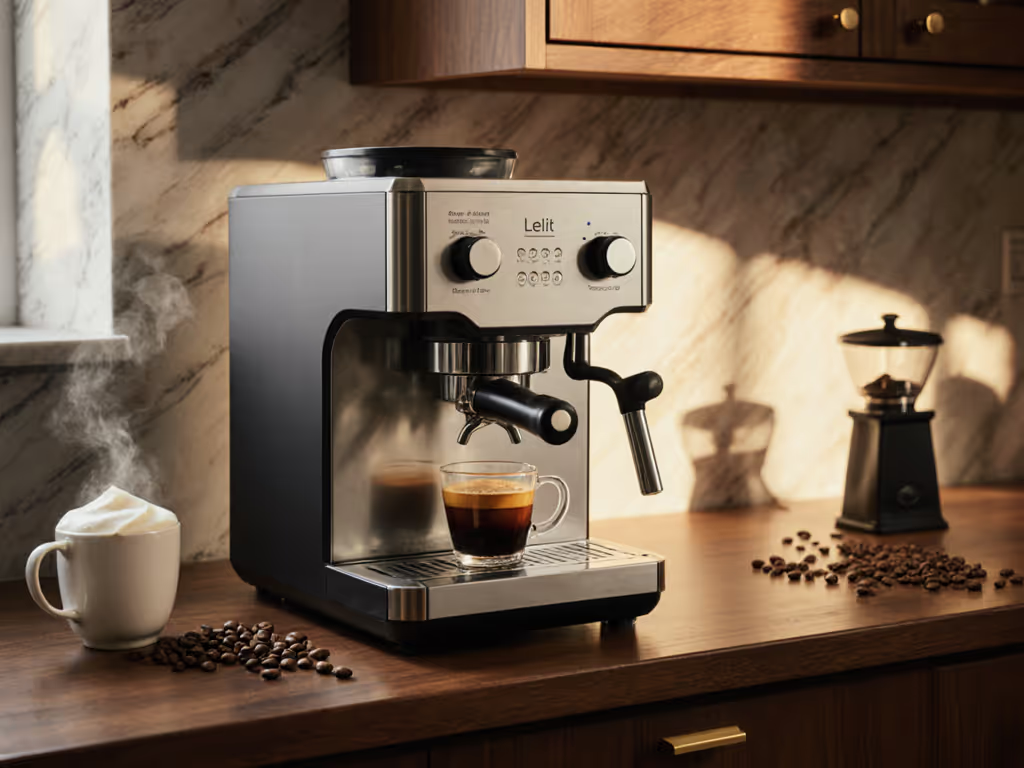
If you want a compact dual boiler that gives you stable temperatures, strong enough steam for two milk drinks back-to-back, and a fast, repeatable morning workflow without E61 warm-up times, the Lelit Elizabeth "Plus" generation is one of the most balanced choices in the prosumer space.
In this lelit elizabeth plus review, I'll treat "Plus" as the latest, updated generation of the Elizabeth platform: PID-controlled dual boilers, advanced Lelit Control Center (LCC), configurable pre-infusion, and smart-plug friendly power controls. It sits squarely in that sweet spot of a dual boiler espresso machine review: more capable and consistent than single boilers or most heat exchangers, without the price or bulk of flagship E61 dual boilers. Not sure if you need two boilers? Read our single vs dual boiler guide to match your routine.
Bounded choices, repeatable shots, taste you can set a clock to.
If you've ever stood at your grinder wondering what to change this time while your kids ask where breakfast is... this machine is designed to cut that hesitation down to a few clear decisions: dose, grind, time.

2. The Core Package: What the Elizabeth Plus Actually Is
Think of the Elizabeth Plus as a compact, electronically-driven dual boiler for home use:
- Two boilers: one dedicated to brewing, one to steaming, each PID-controlled through the Lelit Control Center (LCC).
- Programmable shot buttons (single and double) with built-in timers and individually configurable pre-infusion.
- Quiet vibration pump (similar to the Mara X) rather than a rotary pump, tuned for lower noise.
- No-burn steam wand with a 2-hole tip and a dedicated hot water spout.
- Compact footprint around 32 cm wide, 27 cm deep, 38 cm tall, friendly for small counters and under-cabinet setups.
- Smart-plug ready thanks to a physical on/off switch and a configurable standby mode you can disable.
In daily use, this means:
- You can brew and steam at the same time with stable temperatures.
- You can store your recipes in the machine, not in your head, via programmable shot buttons and boiler temperatures.
- You can warm up faster than most E61 dual boilers while using less counter depth and height.
For many home baristas, that's the first big win against analysis paralysis: the machine narrows your choices to a handful of settings that stay put.
3. Temperature Stability: Why Shots Taste the Same on Tuesday as on Saturday
Among compact dual boilers, Elizabeth Plus temperature stability is one of its strongest selling points.
According to detailed reviews and owner reports, the Elizabeth's PID-controlled brew boiler and electronically managed group keep brew temperature notably stable across back-to-back shots, especially compared to single boilers or small, HX-style home machines.
Key stability features:
- Dedicated brew boiler with PID: You set brew temperature on the LCC; the machine holds it within a narrow band.
- Configurable pre-infusion: You can soften the initial hit of pressure with low-pressure or bloom modes, helping reduce channeling and making shots more forgiving of slight grind/dose errors.
- Shot timer & programmable volumes/times: Once you've dialed in a recipe (say 18 g in, 36 g out in ~28 seconds), you can repeat it at a button press, with the timer live on the display.
Stability isn't glamorous, but it's the difference between one lucky God shot and Tuesday tasting like Saturday.
For you, in the cup, that usually means:
- More sweetness and balance when you hit your target recipe.
- Less wandering into bitter (over-extracted, too hot/too long) or flat (under-extracted, too cool/too short) territory.
If your current machine swings in taste from day to day, the Elizabeth's stable dual boiler and LCC controls are a clear step up.
4. Steam Power & Milk Workflow: Two Cappuccinos, No Waiting
If your routine is "two flat whites before 8:00," you need steam that keeps pace. To nail texture and pouring, follow our consistent milk steaming guide.
Owners consistently report that the Elizabeth's steam boiler is strong enough to steam milk quickly for one to two drinks back-to-back while pulling shots, with steam power that feels comparable to larger prosumer heat exchangers.
Highlights:
- Dedicated steam boiler with its own PID setpoint, adjustable via LCC.
- Pro-style no-burn wand: easy to reposition and safer around kids or groggy partners, while still delivering dry steam.
- Two-hole tip tuned for home pitchers, fast enough, but not so violent that beginners shred the milk.
- Hot water spout that delivers about 200 ml in ~20 seconds, smoothly, handy for Americanos or tea.
In practical terms:
- One 12-16 oz milk drink steams in the ~20-40 second range depending on your boiler setpoint and milk volume.
- You can pull a second shot immediately without waiting for the boiler to recover, thanks to the independent brew boiler.
This is where dual boilers shine for home barista workflow efficiency: you're not forced into a brew-then-steam dance, and your second drink doesn't taste different just because the machine's temperature drifted.
5. Speed & 'Faster Mornings': Warm-Up, Recovery, and Smart Plugs
A big reason people upgrade to a compact dual boiler is time.
Compared to traditional E61 machines, owners and reviewers note that the Elizabeth reaches a practical brewing state significantly faster, thanks to its smaller, directly heated brew boiler and electronically controlled group rather than a large, heavy E61 group that needs to soak heat.
What this means for you:
- You can pull a usable shot in well under 20 minutes, with full stability typically a bit later.
- The 30-minute standby can be disabled, letting you leave the machine on for longer stretches if your schedule is staggered.
- Because the main power switch is a true mechanical switch, you can plug the Elizabeth into a smart plug, schedule auto-on times, or trigger it via voice before you roll out of bed.
Lelit also provides a quick purge shortcut (pressing both shot buttons together) to bypass pre-infusion and flush the group, which helps you stabilize temperature or clear the screen fast in the morning.
If your current setup has you waiting 30-40 minutes for an E61 to heat-soak or wrestling with slow steam, the Elizabeth Plus noticeably tightens that window.
6. Noise, Size, and Ergonomics: Apartment-Friendly by Design
Your household doesn't need to wake up when your espresso does. For quieter picks across categories, see our noise levels comparison for espresso machines.
The Elizabeth uses a quiet vibration pump, the same family of pump used in machines like the Mara X, which owners consistently describe as relatively subdued compared with older vibe-pump machines. It won't be silent, but in an apartment or house with sleeping kids, the difference between this and a loud, rattly single boiler is real.
Ergonomics that matter in daily use:
- Compact footprint (approx. 32 cm W x 27 cm D x 38 cm H) fits most standard counters and under-cabinet spaces more easily than big E61 dual boilers.
- 58 mm portafilter compatible with a wide range of baskets and accessories: VST/IMS baskets, distribution tools, tampers, etc.
- Cup riser included for shorter espresso cups, reducing splashing and improving shot visibility.
- Side-accessible reservoir and accessible internals (via top panel) that make filling and basic maintenance easier in tight kitchens.
For many home users, that combination, small footprint, moderate noise, and good accessory compatibility, is more important than raw boiler volume.
7. Workflow & Controls: LCC, Pre-Infusion, and 'Set-Once' Recipes
This is where the Elizabeth feels like it was designed for bounded options and defaults rather than endless fiddling.
Through the Lelit Control Center (LCC) and front-panel buttons, you can control:
- Brew and steam temperatures independently.
- Two pre-infusion modes:
- Low-pressure pre-infusion (pump runs at reduced pressure, then ramps up).
- Bloom pre-infusion (full-flow pump wetting the puck, pause, then resume).
- Pump run time and total pre-infusion time separately for each pre-infusion mode and for each shot button.
- Standby time, steam boiler enable/disable, and other advanced behaviors via the hidden menu.
Accessing the advanced menu is simple once set:
- Turn the machine off, hold the plus and minus buttons, then power it on to enter advanced LCC settings.
- Use minus to scroll, plus to select; leaving a setting for a few seconds saves it.
There's also a shortcut: long pressing the minus button toggles the steam boiler on/off, which is useful if you want pure espresso mode and lower energy use. Then level up your recipes with our How to dial in espresso guide.
Once you lock in a few recipes, say a "comfort milk drink" button and a "fruity straight espresso" button, the machine becomes a simple, morning-friendly appliance: select, grind, tamp, press.
For an optimization-minded home barista, this is where the Elizabeth shines: it invites you to do the work once (dial-in, set pre-infusion, choose temps), then rewards you with low-effort repeatability.
8. Cleanup & Maintenance: Dry Pucks, Clear Routines
Maintenance anxiety is real: backflushing, descaling, water... it adds up. Start with the right water using our best espresso water guide to protect flavor and internals.
The Elizabeth tries to make this simpler:
- A three-way solenoid valve helps yield relatively dry pucks, making knockouts cleaner and reducing soggy puck mess.
- The no-burn steam wand wipes down easily; many owners note that milk doesn't bake on as aggressively as on hot, single-wall wands.
- The LCC and manual provide guidance for backflushing frequency and other maintenance tasks, similar to other prosumer machines.
Compared with E61 machines, there are fewer mechanical parts related to the brew group to lubricate, but you are trading that for more dependence on electronics (LCC board, probes, sensors).
From user forums and owner reports:
- Long-term owners generally report good reliability, with most issues related to early-batch quirks (e.g., valves, minor leaks) that Lelit has iterated on in later versions.
- Routine maintenance, water filter changes, occasional descaling (if using harder water), and backflushing, is in line with other dual boilers.
If you want cleanup measured in seconds, you'll still need a good knockbox, a quick wiping habit, and a rinse routine. But the Elizabeth gives you dry pucks, a clean steam wand, and predictable maintenance intervals to work with.
9. Dual Boiler Value Assessment: Elizabeth Plus vs Key Alternatives
Let's place this dual boiler espresso machine review in context. How does the Elizabeth Plus stack up against other popular dual boilers and near-competitors?
Below is a high-level, experience-based comparison (models representative, not exhaustive):
| Machine | Type | Strengths for Home Use | Common Trade-Offs |
|---|---|---|---|
| Lelit Elizabeth Plus (current) | Dual boiler | Compact, fast warm-up, advanced LCC, great pre-infusion, strong steam for size, smart-plug friendly. | Vibration pump (not rotary), smaller steam boiler than big E61s, electronics-heavy. |
| Breville Dual Boiler | Dual boiler | Excellent temp control, user-friendly interface, low purchase price, built-in timers. | More plastic, more internal complexity, can require more frequent servicing and parts long-term. |
| Rancilio Silvia Pro X | Dual boiler | Saturated group feel, strong steam, robust build. | Higher price, louder pump, larger footprint, simpler interface (less pre-infusion control). |
| Profitec Pro 300 | Dual boiler | Compact, solid German build, straightforward PID. | Simpler feature set (no advanced pre-infusion), more "manual" workflow. |
| Lelit Mara X | HX | E61 group, great temperature-management logic, strong steam. | HX learning curve, longer warm-up, single boiler for brew/steam (no true dual). |
Where the Elizabeth Plus tends to win on value:
- Feature density vs. price: Advanced pre-infusion, dual boilers, PID on both boilers, smart-plug-friendly power, in a compact chassis.
- Workflow efficiency: It's designed for home barista workflow efficiency, not cafe-style continuous service.
- Practical stability: Very good temperature stability for back-to-back drinks without E61 warm-up times.
Where you might choose something else:
- If you want cafe-style feel and upgradability with big copper boilers and a heavy E61 group, a larger E61 dual boiler or HX (like a Mara X or Profitec 500) might fit better.
- If you prioritize rock-bottom price and don't mind more long-term tinkering, a Breville Dual Boiler can be attractive.
- If you want a more industrial, classic build and don't care about advanced pre-infusion, a Profitec Pro 300 or Silvia Pro X might match your preferences.
From a dual boiler value assessment perspective, the Elizabeth Plus hits a strong middle ground: modern features, compact size, serious performance, and a focus on home workflows rather than cafe mimicry.
10. Who the Elizabeth Plus Is Perfect For, and Who Should Skip It
Ideal Match
You're in the Elizabeth Plus sweet spot if:
- Your routine is 1-4 drinks/day, often two milk drinks back-to-back.
- You care about repeatability more than endless tinkering.
- You have a decent grinder and want the machine to stop being the limiting factor.
- You live in a shared space where noise, warm-up time, and counter depth matter.
- You like the idea of "set and forget" recipes with programmable buttons and pre-infusion.
In other words: you want bounded choices, repeatable shots, and taste you can set a clock to.
Maybe Look Elsewhere If...
- You want the heft and ritual of an E61 group and don't mind 30-45 minute warm-ups.
- You insist on a rotary pump and plumb-in capability for ultra-quiet operation and fixed installation.
- You prefer an ultra-simple machine with no electronics beyond a PID, something like a basic HX or minimalist dual boiler.
- You're on a tight budget where a used HX or Breville Dual Boiler makes more sense.
If you're unsure, a simple calibration exercise helps: time a typical morning from "machine off" to "last cup finished," count how many drinks you make, and note whether those drinks are mostly milk-forward or espresso-forward. Match that to the strengths above.
11. How to Decide Your Next Step (Without Getting Lost in Reviews)
You don't need another dozen conflicting videos to decide.
Instead, use the Elizabeth Plus as a reference point in your own dual boiler espresso machine review process:
-
Define your routine in numbers
- Drinks per day (and per session).
- Milk vs. straight espresso ratio.
- Warm-up tolerance (5, 15, 30 minutes?).
-
Set your non-negotiables For example: dual boiler, compact footprint, smart-plug compatibility, or rotary pump.
-
Choose your "control" machine Let the Elizabeth Plus be your baseline. For each competitor you're considering, ask:
- Does it beat the Elizabeth at temperature stability?
- Is its workflow faster or slower for my routine?
- Is its maintenance heavier or lighter long term?
-
Map flavor to workflow Decide whether your priority is milk-drink speed (steam first), espresso nuance (pre-infusion and temperature control), or a balance. The Elizabeth is built for that balance.
-
Plan your first week with the machine Before buying, sketch your first-week recipe plan: starting dose, grind range, target shot time, and boiler temps. This turns any new machine into a structured experiment instead of an open-ended puzzle.
If, after this exercise, the Elizabeth Plus still looks like it matches your numbers, two cappuccinos in under 10 minutes, compact, quiet enough, and stable, then it's a strong contender for your counter.
And if you discover that you'd rather lean into heavy E61 ritual, ultra-budget, or cafe-level steaming power, that clarity is just as valuable. Either way, you've moved from review surfing to a simple, repeatable decision framework, exactly the kind of constraint that brews confidence along with your espresso.
Related Articles