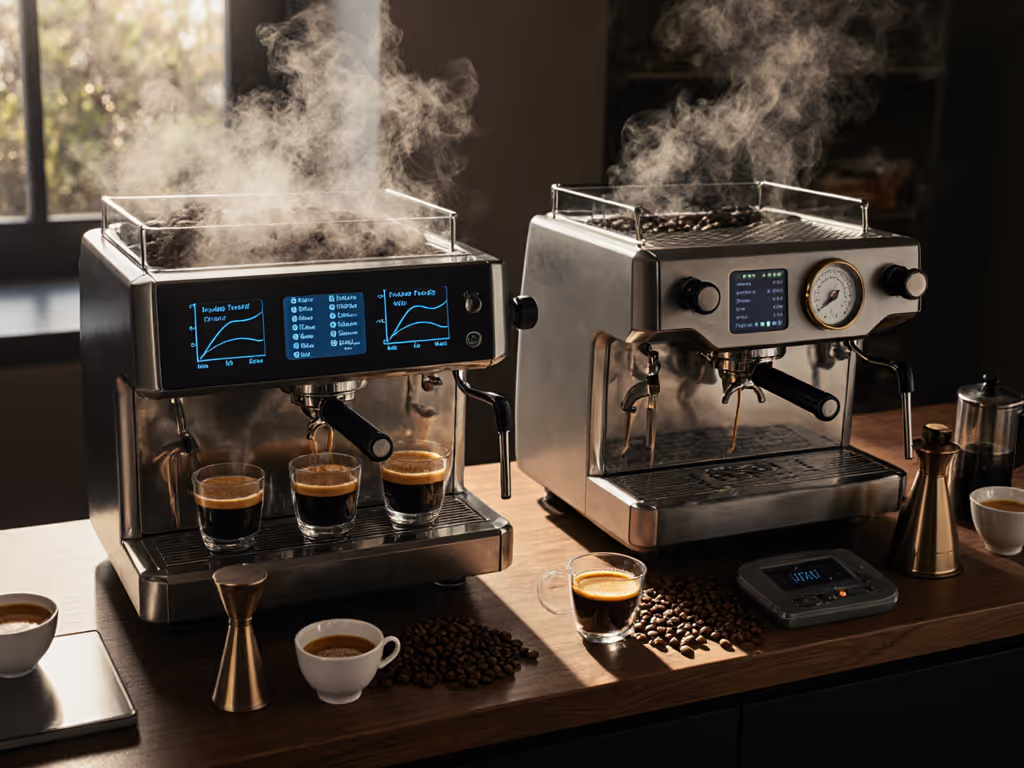
Espresso Recovery Time: Tested for Back-to-Back Drinks
By Maya Desai • 15th Mar
Espresso machine recovery time (the interval a boiler needs to reheat after pulling a shot) is one of the most underestimated variables in home brewing. Yet it governs everything from back-to-back brewing performance to whether your second cappuccino tastes as balanced as your first. This guide walks through what recovery time is, how to measure it on your machine, and what thresholds matter for weekday routines.
Understanding Boiler Recovery and Thermal Stability
What exactly is recovery time?
Recovery time is the duration between the end of one extraction and the moment your boiler returns to its set temperature and stabilizes throughout the brew group. When you pull a 30-second double shot, you introduce a significant volume of cold water into the boiler, causing a temperature drop. The heating element then engages to bring the water back to your target (typically 90-96°C for espresso brewing). That reheating period is your recovery window.[2]
The practical difference matters immediately: if you pull a second shot before the entire brew path, not just the boiler but the group head and surrounding metal, is thermally stable, your extraction will reflect that. Water that is too cool under-extracts; water that is too hot over-extracts.[2] Consistency beats charisma when the alarm is barely past snooze. On a machine without temperature feedback, you are operating blind. On one with a PID display, you can watch the process and time it properly.
How much does recovery time vary by machine type?
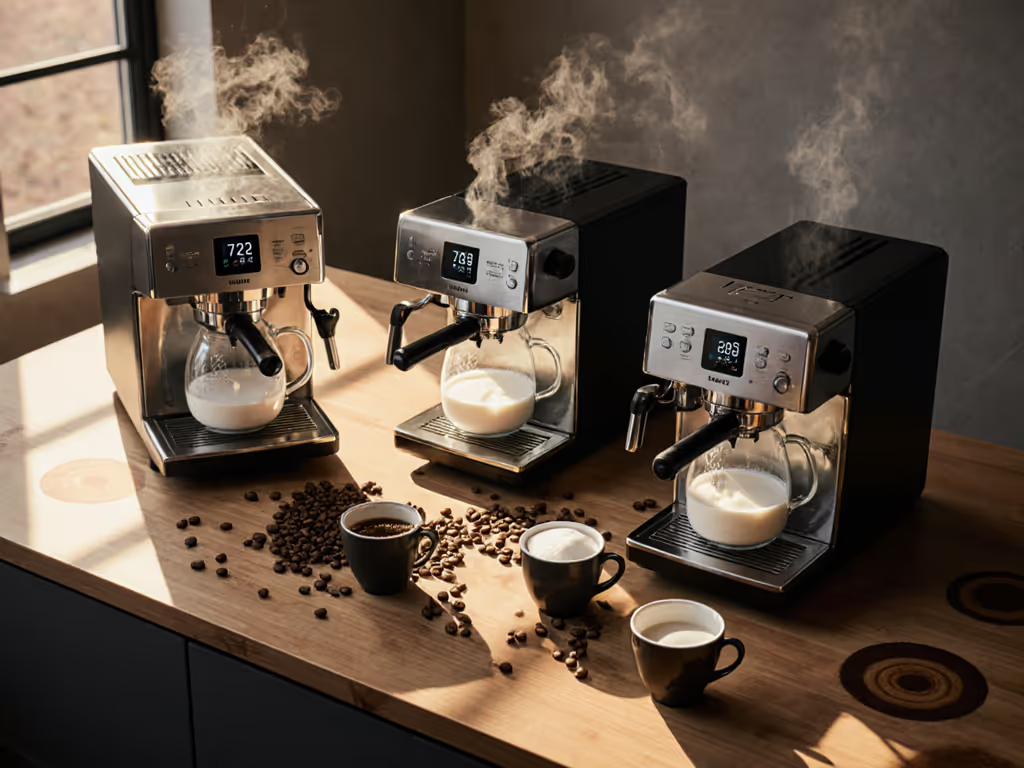
On single-boiler machines, typical recovery falls between 30-50 seconds after a standard 30-second espresso shot.[1] Dual-boiler machines recover faster because the steam boiler does not interfere with brew temperature. For a deeper look at how boiler configuration impacts recovery and back-to-back performance, see our single vs dual boiler comparison. The Breville Barista Express and similar mid-range single-boilers should complete recovery within 60-90 seconds under normal conditions.[3]
Abnormally long recovery (two minutes or more) signals either undersized heating elements, worn thermostats, or PID tuning issues.[1] Forum testing has confirmed that a healthy single-boiler machine recovers in under 45 seconds for a typical espresso extraction.
Key Testing Variables: How Recovery Behaves
What shot volume affects recovery time?
Recovery time is highly dependent on the volume of cold water entering the boiler. A blank 30-second water flush introduces different thermal stress than a full espresso shot with grounds acting as a filter.[1] For transparent test methodology, standardize your baseline: pull a blank double shot (roughly 2 oz of water) and time from flow-stop to when your PID or light indicator returns to full-ready status.
One tester found recovery of 48 seconds after a blank double, but only 25 seconds after a full espresso shot, the difference stemming from earlier heater engagement when the temperature sensor detected a drop mid-extraction.[1] This variability is why "average" recovery figures are less useful than your own machine's profile.
Does machine warm-up matter for shot consistency?
Yes. A machine that runs 24/7 maintains baseline thermal mass differently from one warmed up fresh each morning. For testing purposes, run a two-shot warm-up sequence (two blank water shots with 30 seconds between them) before your first espresso. This is standard practice at professional calibration houses and aligns the group head temperature with the boiler.[1] Chris Coffee uses this exact routine when bench-testing machines with a Scace thermofilter.
After warm-up, note that your PID (if equipped) should stabilize at your set point. Do not pull your first shot the instant the display hits 93°C; wait 15-30 seconds more for thermal equilibrium throughout the brew path.[2] The water temperature may read correct, but the group head (hanging off the boiler and exposed to ambient air) may still cool. A brief stabilization window removes that variable from your first extraction.
Back-to-Back Brewing: The Real-World Workflow
What is the safe interval between shots for a home machine?
For typical home single-boiler machines, pulling two shots with 2 minutes between them poses no risk to pumps or heating elements; most designs tolerate continuous back-to-back brewing.[3] The constraint is not mechanical wear but taste. If you do not allow full recovery, your second shot will taste sour and thin because the brew water is under-temperature. If that happens, use our espresso troubleshooting guide to fix sour and bitter shots fast.
The rhythm that works for most home baristas is this:[2]
- Pull your first shot. Watch your PID temperature drop during extraction.
- Knock out the puck immediately and wipe the portafilter.
- Grind, dose, and tamp your second puck while the machine reheats (typically 25-40 seconds).
- By the time you lock in the portafilter, the machine will have recovered and stabilized. Pull your second shot.
This workflow turns a guessing game into a repeatable, data-driven rhythm. You are not staring at a timer; you are using the natural recovery cycle as part of your prep sequence.
What if I need three shots in quick succession?
Three consecutive shots test recovery differently. After the second shot, you have 25-40 seconds of reheating. If you spend 20 seconds on puck prep (grinding, dosing, tamping), you will have 5-20 seconds of additional stabilization before locking in the third portafilter. This is tight but feasible. If your workflow eats more than 40 seconds per shot (if your grinder is slow or your tamping ritual is elaborate) you will naturally have sufficient recovery time built in.
Machines with active PID adjustment handle this better than models with passive thermostats. The PID can be fine-tuned to avoid overshooting the target temperature on recovery, which would reverse the extraction problem (over-extraction on the third shot).[2]
Measuring Your Own Machine's Recovery Profile
How do I test recovery time at home?
You need minimal equipment: a PID-enabled machine (or a surface thermometer if you lack one), a timer, and a kitchen scale or measuring cup.
Procedure:
- Warm up the machine with two blank water shots as noted above.
- Set your target temperature (e.g., 93°C) and allow it to stabilize for 5 minutes.
- Pull a blank double shot (2 oz of water). Note the exact moment flow stops.
- Start your timer.
- Watch the PID or temperature indicator. Record the moment it returns to your set point and holds steady for at least 10 seconds.
- This interval is your recovery time.
- Repeat three times and average the results. Variability of ±3 seconds is normal; anything larger suggests tuning drift.
Do this on a single 20 A circuit (standard US outlet) to avoid electrical variance. If recovery is consistently over 60 seconds, check that your heating element is not fouled with mineral deposits; descaling may restore normal recovery. Prevent future scale and stabilize taste with our espresso water quality guide. If overshooting occurs (temperature spikes 2°C+ above set point), your PID's P (proportional) value is likely too high; consult your machine manual or a qualified technician.
Why Recovery Time Matters for Weekday Espresso
What does consistent recovery time enable?
During a month of 6 a.m. tests on two similar machines, I logged shot temperatures, pressure curves, and extraction variance across multiple days. One machine recovered predictably every morning: temperature drop, steady rebound, stable hold. The second machine showed erratic recovery: some days 35 seconds, some days 65 seconds. The erratic machine tasted brilliant on Saturday when I had time to dial in and adjust. By Wednesday, it drifted. The stable machine held its profile all week. That gap (repeatable performance versus charming chaos) taught me that weekday-proof espresso is built on consistent thermal stability, not brilliant one-off shots.
Recovery consistency underpins this. If your machine recovers in 38 ± 4 seconds every time, you can anchor your workflow to a rhythm. Grind-dose-tamp takes you 25 seconds; another 15 seconds of stabilization; you lock in and pull. Your second shot extracts at the same temperature window as your first. Over a week, this compounds into reliable, repeatable café-quality drinks.
How does PID tuning improve recovery?
A PID controller manages three parameters: proportional (P), integral (I), and derivative (D) gains, to modulate heating power. If recovery is slow, increasing P tells the heater to act more aggressively; if recovery overshoots and oscillates, decreasing P or increasing D smooths the approach.[2] The benefit is that once tuned, a PID machine recovers with much tighter tolerance than an on-off thermostat, which simply flips the heater on or off at a fixed trigger point.
PID-equipped machines in the mid-range ($1,200-$2,000) demonstrate recovery consistency within ±3-5°C and stabilize within 40-50 seconds. Budget single-boilers without PID often see ±8-10°C swings and recover in 60+ seconds.[2] This is one reason prosumer upgraders cite PID as a priority: it transforms recovery from an afterthought into a controlled variable.
Common Recovery Issues and What to Check
| Symptom | Likely Cause | Check First |
|---|---|---|
| Recovery is very slow (90+ seconds) | Undersized heater or mineral buildup | Descale; check heating element wattage |
| Temperature overshoots set point significantly | PID P value too high | Consult manual; reduce P in small steps |
| Recovery is erratic (varies by 20°C+) | Worn thermostat or faulty sensor | Have thermostat tested; replace if corroded |
| Machine stays at set temperature briefly, then drops | Insufficient insulation or ambient temperature shift | Ensure stable room temperature; allow longer stabilization |
Summary and Final Verdict
Espresso machine recovery time is not a vanity metric; it is the foundation of back-to-back brewing consistency. Healthy single-boiler machines recover in 30-50 seconds; anything over 60 seconds warrants investigation. Dual-boilers and heat exchangers recover faster but cost more. Not sure which path fits your routine? Start with our HX vs dual boiler breakdown.
If your current routine involves pulling only one shot per session, recovery time has minimal impact on you. If you regularly brew two or more drinks in a morning (cappuccino plus long black, back-to-back espressos for guests), recovery time directly affects whether your second drink tastes balanced or sour.
For pragmatic home baristas, the hierarchy is:
- Prioritize machines with PID controllers if you pull 2+ shots regularly. The consistency outweighs the price premium.
- Measure your own machine's recovery using a thermometer and timer. Do not rely on marketing claims; test under your electrical supply and warm-up protocol.
- Build recovery time into your workflow rhythm, not around it. Spend 20-30 seconds on puck prep while the machine reheats; lock in and extract. This is weekday-proof espresso.
- If recovery exceeds 70 seconds consistently, descale or have the machine inspected. Recovery time rarely improves with age; it either remains stable or gradually worsens.
Consistency beats charisma when the alarm is barely past snooze. Recovery time is where that consistency lives.