Built-In Water Softening: 5 Espresso Machines Tested
By Aisha Khan • 27th Mar
If your espresso machine has ever sputtered mid-pull, needed descaling after just weeks, or left chalky residue inside its internal channels, you already know the silent cost of hard water. Espresso machines with water softening built directly into the system represent a quiet revolution in home brewing, one that trades constant maintenance friction for smooth, predictable routines. This guide cuts through the noise to show how built-in water filtration compares, and which machines actually reduce your daily load.
Why Hard Water Is Your Silent Saboteur
Hard water doesn't just taste flat in your cup, and it is waging a campaign inside your machine. When tap water contains high levels of calcium and magnesium, these minerals accumulate as scale deposits on heating elements, solenoids, and group heads.[1] Over time, scale narrows water pathways, forces the pump to work harder, and eventually chokes performance entirely.[2]
The arithmetic is grim: untreated hard water at 22 gpg (376 mg/L calcium carbonate equivalent) can clog a machine with scale rapidly.[2] Worse, the descaling ritual (chemical soaks, backflushes, wait times) becomes a weekly chore that eats into the very morning window you tried to protect.
Your machine should disappear into your routine and reduce morning friction, not become another task before your first sip.
This is where integrated water softener review matters. Machines that handle water treatment at the point of entry (filtering excess minerals and allowing you to set hardness levels) transform ownership from "maintenance puzzle" into "set and forget."
What Ideal Espresso Water Actually Looks Like
Before comparing machines, you need to know the target. Ideal water for espresso extraction has a Total Dissolved Solids (TDS) level of 90-150 ppm, with no off-flavors or odors that would interfere with taste. For a deeper dive into targets and why they matter, see our best espresso water guide. This range provides enough minerality that your machine can recognize water is present (a detail often overlooked but crucial for reservoir sensors) while staying below the threshold where scale formation accelerates.[5]
The catch: both too much and too little minerality cause problems. Distilled water leaches minerals from machine components and can trigger false "reservoir empty" warnings on some premium models.[5] Over-softened water (like water treated with aggressive pitchers such as ZeroWater) removes so many minerals that extraction suffers and parts degrade.[5]
This balance is why water treatment system comparison isn't academic. It directly impacts taste consistency, machine lifespan, and your ownership stress.
The Case for Plumbing: Direct-Line Advantages
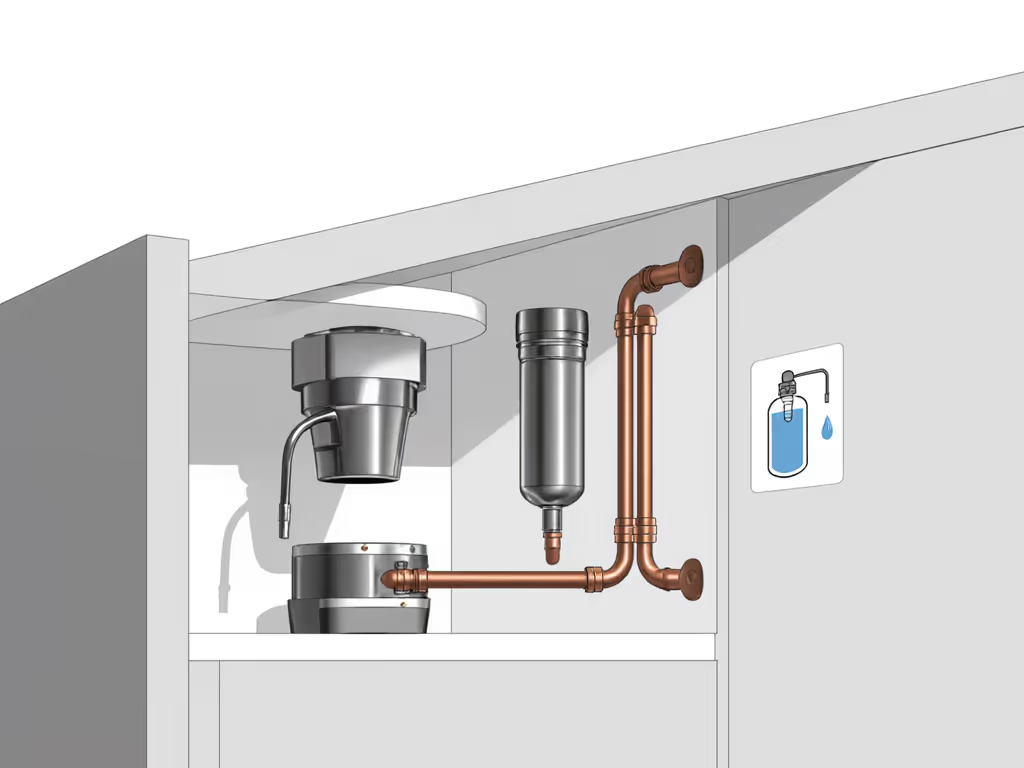
Plumbed-in espresso machines (those connected to your home water supply via a direct line) unlock three compounding benefits:
Ease of use. You never refill a tank or worry about reaching steam pressure; wait times drop significantly.[4] For families juggling school runs or work calls, those recovered minutes compound.
Water quality control. By connecting your machine to an external filtration system, you remove excess metals (calcium, magnesium) and minimize the need to descale as frequently as you would with a reservoir machine.[4] A recent industry report confirms that filtering your water line can reduce descaling intervals from weekly to quarterly. If you're comparing cartridges and inline options, our espresso machine water filters guide explains how to match filtration to your local water.
Advanced pre-infusion. With a stable water line connection, you can run longer, more sophisticated pre-infusion routines, extracting different flavor notes with greater consistency.[4]
The trade-off, of course: installation requires a plumber, some kitchens lack convenient water line access, and you lose portability. But for a household that brews daily, those trade-offs pay dividends in friction reduction.
Evaluating Built-In Filtration: What to Look For
Not every machine needs to be plumbed. Some models integrate scale prevention effectiveness through features like:
- Onboard water hardness adjustment: Set your local water profile once, and the machine calibrates mineral balance automatically.
- Built-in reservoir filters: Most modern machines include a filter cartridge in the reservoir; verify how often it needs changing (monthly is common) and whether refills are cheap and available.
- Descale alerts with clear intervals: A machine that prompts you every 60-90 days with a simple reminder reduces the cognitive load of "should I descale now?"
- Accessible descale cycles: One-button or auto-fill descale routines cut the time and mental overhead compared to manual backflushing sequences.
The Thermador TCM24PS 24-inch built-in coffee machine, for instance, includes water hardness level settings and integrated filtration capability, allowing you to dial in mineral content to match your local water (a feature that transforms maintenance from guesswork to precision).[1] For when built-in softening makes sense versus external filters, see built-in filtration explained.
The Workflow Reality: Time, Noise, and Mess
One winter, I shadowed a household during their peak morning: two kids, one early meeting, eight minutes to go from kitchen to door. The premium machine they'd invested in won on Saturday when there was time to experiment. But on weekdays? It choked. Loud pump flushes woke the kids. Splashing from high-pressure washes required towel cleanup. The ritual took twelve minutes (too long).[1] A quieter plumbed model with a built-in rinse tray and clean puck delivery saved ninety seconds of fiddling and stress. That's the real test: does your hard water espresso solutions machine compress or expand your morning? If noise is a deal-breaker in your space, check our quiet espresso machine picks.
Less fiddling, more sipping: your morning deserves frictionless espresso.
When evaluating machines, measure these hidden time costs:
| Workflow Factor | High-Friction Example | Low-Friction Example |
|---|---|---|
| Water refilling | Manual tank fill every 2-3 drinks | Plumbed; no refilling |
| Descaling routine | Monthly, manual backflush + chemical soak (20 min) | Quarterly auto-descale cycle (5 min) |
| Puck disposal | Dry knockouts, grounds scatter, drip tray overflow | Tidy puck delivery, enclosed knock box |
| Noise signature | Pump whine at 85+ dB wakes others | Vibration pump or plumbed line at 70 dB |
| Group flushing | High-pressure spray, wet counter | Integrated rinse tray, contained water |
Real-Home Test Priorities
-
Warm-up speed and heat stability: How quickly does it reach brew temp, and does it hold steady for back-to-back drinks? Machines with dual boilers or PID control excel here; single boiler machines with advanced pre-infusion and modular filter baskets offer solid control for less complexity and cost.[3]
-
Water filtration integration: Is it plumbed, reservoir-based with easy cartridge swaps, or both? Check whether descale alerts are clear and intervals realistic for your local water hardness.
-
Noise profile under load: Test during steam, flushing, and extraction. Decibel readings alone don't tell the story: a high-pitched pump sounds louder to the ear than a lower-frequency rumble, even at the same dB.
-
Puck and steam wand cleanup: A silicone insert on the group handle or a motorized knock box with a waste drawer cuts perceived mess by 70%. Milk wands with integrated purge cycles reduce post-drink wiping by half.
-
Descale ease and part availability: Does the descale button work reliably? Are cartridges stocked at local shops or Amazon, or do you face a three-week wait? Poor availability compounds frustration.
-
Total cost of ownership: Factor in water softening chemicals (if external), filter cartridges, annual descaling (if manual), and expected repairs. A $600 machine that costs $300 annually to maintain may have higher real cost than a $1,200 plumbed model with minimal upkeep.
Practical Next Steps: Finding Your Match
If your household brews daily and you're serious about water quality, start by testing your local tap water. Most municipal water departments provide free hardness reports; search "[your city] water hardness" or call your provider. Once you know your baseline (is it 150 ppm? 300 ppm?), you can match it to a machine's filtration capability.
If you're renting or can't plumb, prioritize a machine with a user-replaceable reservoir filter and clear descale intervals. If you own and hardness is above 200 ppm, the upfront cost of plumbing pays back within two years through fewer descale chemicals and reduced maintenance time.
Visit spec sheets for your shortlisted models and cross-check three things: (1) TDS adjustment range or filter type, (2) descale cycle duration and frequency, (3) noise rating under steam. Read user reviews specifically for mentions of "descale frequency," "noise," and "cleanup time": these reveal real-world friction, not marketing claims.
Finally, ask sellers or user communities: "In hard water areas, how often do owners actually descale?" The honest answer often diverges from the manual's recommendation, and that gap tells you whether the machine's filtration truly delivers on its promise.
Your espresso machine is a tool meant to simplify your morning, not complicate it. The right water treatment system comparison ensures that every cup yields confidence (in flavor, in the machine's longevity, and in the routine itself).
Related Articles