E61 vs Saturated Group Heads: Which Wins for Consistent Espresso?
By Luca Moretti • 2nd Nov
When beginners freeze at their grinders, I pull out my three-setting card (dose, grind, time), and we brew three shots. The confidence that follows? It's born from constraints. That's why the e61 vs saturated group head debate matters more than you think. Your group head isn't just brass or steel, it's the heartbeat of espresso extraction consistency. Let's cut through the jargon with a practical espresso group head comparison focused on one thing: repeatable results before your first sip of coffee.
Most home baristas waste mornings chasing temperature stability. I've seen it for 12 years. You want shots that taste the same today as they will next Tuesday, without a PhD in thermodynamics. So, we'll ditch theoretical perfection and focus on bounded choices, repeatable shots. Here's what truly impacts your cup:
1. Thermal Stability: The Silent Shot Killer
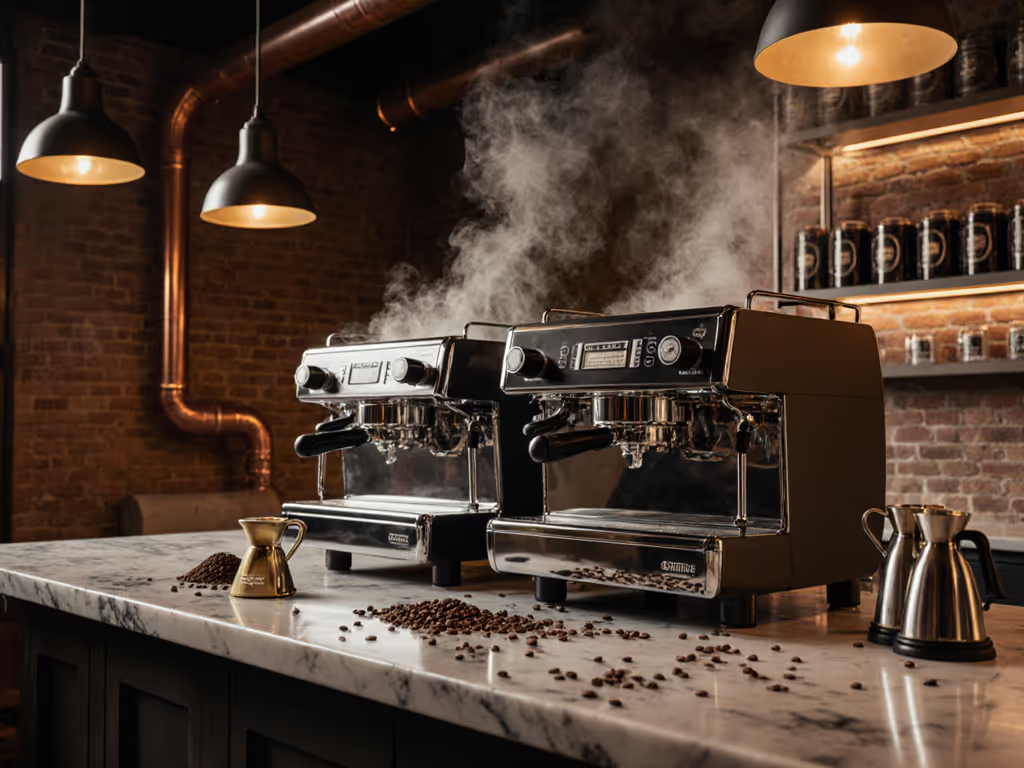
Temperature swings between 92°C to 96°C create wildly different extractions: one shot sour, the next burnt. Saturated group heads (like La Marzocco's GS3) submerge the group directly in the boiler water, acting as part of the boiler. This minimizes heat loss during back-to-back shots. A thermal stability comparison reveals saturated designs hold ±0.5°C variance, critical for milk drinkers needing two identical cappuccinos.
E61 group heads (Rocket R58, Ascaso Steel Duo) use a thermosiphon loop. While solid, they can drop 2 to 3°C between shots unless you run a cooling flush. Newer PID-controlled E61s narrow this gap, but physics still favors saturation for true stability. If your pain point is "inconsistent shots day to day," saturated wins, but at what cost?
Bounded choices mean acknowledging trade-offs: saturation gives stability but demands budget and space.
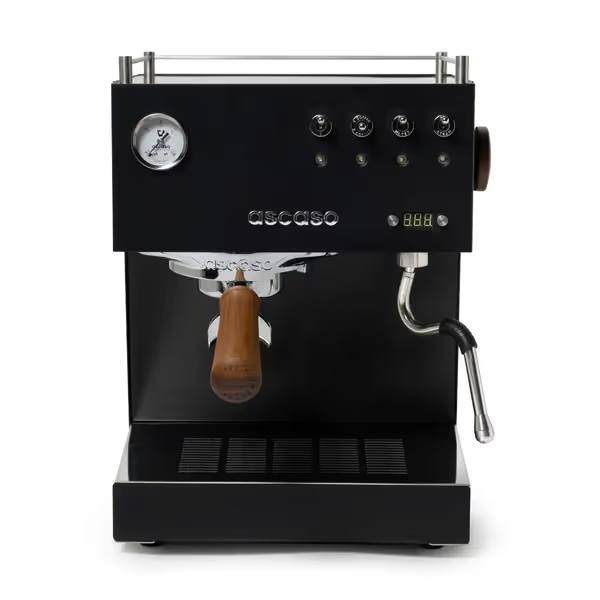
Ascaso Steel DUO Espresso Machine
Consistent, programmable espresso perfection for your morning routine.
$2095
Heating SystemDual Thermoblock
Heating SystemDual Thermoblock
Pros
Delivers consistently perfect shots with PID control.
Fast heat-up and continuous steam for multiple drinks.
Programmable volumetric controls for precise repeatability.
Cons
Mixed feedback on steam wand performance and adjustability.
Included baskets may not suit all users.
Customers find this espresso machine produces excellent results, with one noting it consistently delivers perfect shots. They appreciate its appearance and temperature control features, with one describing it as a "beautiful $2k espresso machine."
Customers find this espresso machine produces excellent results, with one noting it consistently delivers perfect shots. They appreciate its appearance and temperature control features, with one describing it as a "beautiful $2k espresso machine."
2. Warm-Up Time: Your Morning Ritual's Enemy
Busy households need coffee now. If you're weighing recovery time and milk steaming power, see our HX vs dual boiler comparison. Saturated group heads heat in 15 to 20 minutes (boiler heats group simultaneously). E61 group heads take 25 to 30 minutes, the thermosiphon loop must fully circulate. That 10-minute gap wrecks rushed mornings.
Group head heat retention post-warm-up matters too. Saturated designs recover faster between shots (ideal for family kitchens). But if you pull one morning shot, E61's slower cooldown gives gentle pre-infusion (a hidden perk for finicky single-origin beans). For the "warm-up lag derailing short routines" crowd, E61's slower start may ironically save time if you're not brewing multiples.
3. Maintenance Reality: The Hidden Cost of "Commercial Grade"
"Commercial group head technology" sounds premium, until gaskets leak at 7 a.m. Saturated groups have fewer external parts (no complex thermosiphon tubes), but replacing internal boiler-sealed components costs 3x more. Parts scarcity frustrates home users; La Marzocco technicians outnumber saturated machine owners.
E61's modular design shines here. Gaskets and shower screens are user-replaceable ($15 parts, 10 minutes). Use our espresso machine maintenance guide for a simple daily-weekly routine that prevents those 7 a.m. gasket surprises. This directly addresses "maintenance confusion and fear of damage," a top pain point for pragmatic buyers. If repairability tops your priority list, E61's simplicity beats saturated's "pro" allure.
4. Home Kitchen Practicality: Size, Noise, and Sanity
Saturated groups require larger boilers (and counter space). They're built for 100-shot cafes, not 10" deep countertops. E61 machines fit compact kitchens but generate more noise during warm-up (thermosiphon circulation). For apartment dwellers, E61's quieter operation once hot matters more than warm-up rumbles.
Budget-wise, saturated entry starts at $4,500 (La Marzocco Linea Mini). E61s start at $1,500 (like the Ascaso Steel Duo). Your "pragmatic first-time buyer vs prosumer upgrader" split is real here. If hidden ownership costs haunt your dreams, E61's cheaper parts and serviceability win long-term.
5. Your Actual Workflow: What Really Fixes Inconsistent Shots
Here's the truth no one shares: Both designs fail if your dose/grind/time isn't dialed. Follow our dialing in espresso guide to set dose, grind, and time systematically. I've fixed "unstable E61" complaints by simply adjusting dose by 0.2g. Thermal stability solves one variable, but most home inconsistencies stem from grind size or puck prep.
My field-tested advice: Prioritize forgiving parameters over theoretical perfection. Saturated groups demand precise pressure profiling to shine. If you're exploring this, start with our pressure profiling guide. E61s work with standard 18g/36g/26s recipes. If "difficulty dialing in quickly" haunts you, choose E61 and master dose control first. Use it as a sensory anchor: track sweetness (under-extracted = sour, over-extracted = bitter) while adjusting one variable at a time.
The Verdict: Constraints Create Confidence
Saturated group heads win on pure thermal stability comparison, but only if you pull 5+ shots daily. For 95% of home users, a well-built E61 (like the Ascaso Steel Duo) with PID offers 90% of the stability at half the cost, and less complexity. Remember my grinder card story? Same principle applies here.
Stop chasing "competition-level" specs. Your goal isn't lab-perfect temperature curves, it's repeatable taste you can set a clock to. Lock in dose first, then grind, then time. Record settings. Trust the process. When you treat your group head as a tool within bounded options, not a magic box, confidence replaces doubt. And that's when your espresso truly wins.
Related Articles