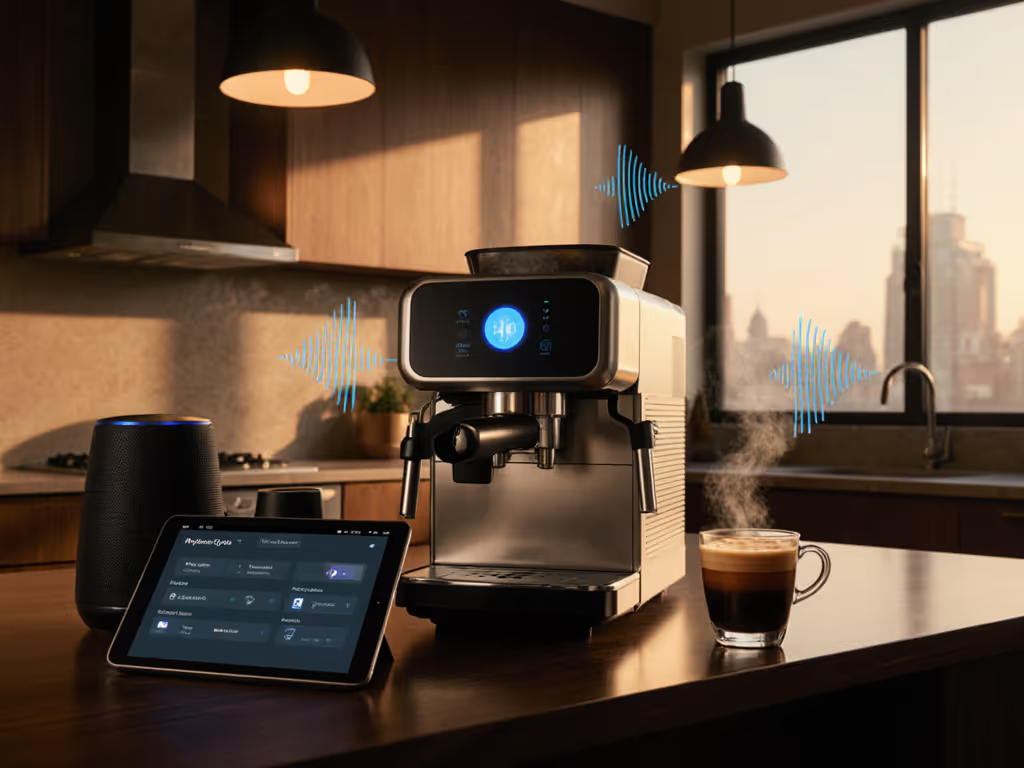
Espresso Temperature Profiling: Manual vs Programmable vs AI
By Daniel Ortiz • 6th May
The Problem: Why Your Shots Taste Different Every Morning
You pull two espresso shots ten minutes apart, and they taste nothing alike. The first pulls bright and tart; the second tastes muted and flat. Your grind is identical. Your tamp is the same. The only variable? Water temperature drifted during the extraction.
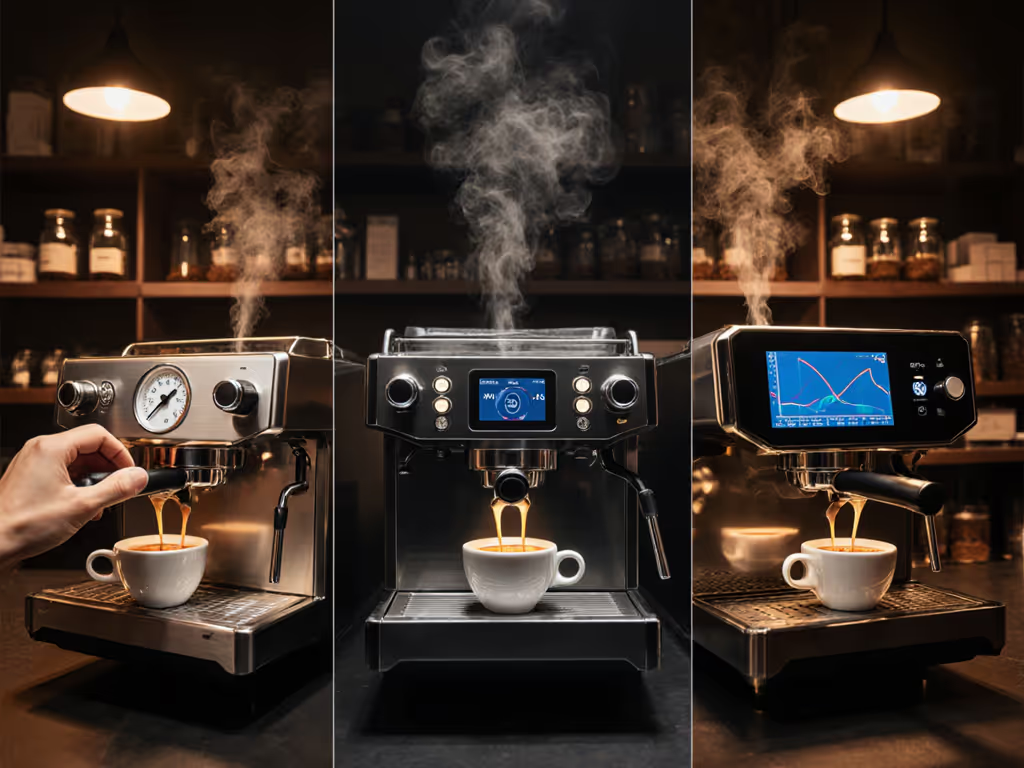
This is where espresso machine temp profiling enters the conversation, and where three very different implementation approaches diverge sharply in cost, usability, and total ownership outcome. For a hands-on walkthrough of temperature profiling fundamentals, see our temperature profiling guide.
Temperature profiling implementation comparison isn't academic. It directly affects shot consistency, extraction speed, downtime, and (critically) how much you spend on a machine and its maintenance over three to five years. Most reviews gloss over this lifecycle math. I don't.
Why Temperature Matters: The Agitation
Temperature profiling is the practice of deliberately raising, lowering, or holding water temperature during espresso extraction to optimize which compounds the water dissolves at which moment. Early extraction favors sweetness and acidity; late extraction risks bitterness and harshness. Control the temperature curve, and you control the flavor balance.
But here's what the enthusiast blogs won't tell you: each implementation path carries hidden costs.
Manual profiling requires constant thermometer reading, dial adjustment, and operator skill. Miss the timing by two seconds? Your shot profile is garbage. Do this daily before work? Cognitive load spikes, morning prep time doubles, and consistency crashes on bad days.
Programmable profiles automate curve execution (in theory). In practice, they add complexity: firmware updates (downtime), settings menus (learning curve), and calibration procedures (service contacts). And they're expensive: programmable machines typically cost $600-$900 more than manual equivalents at entry-level, and $1,200-$2,500 more at prosumer tiers.
AI-assisted systems promise to learn your taste preference and adjust automatically. Sounds dream-like. Reality? They're nascent, tied to WiFi, dependent on proprietary apps, and (if a sensor fails) you're locked out of manual override. Repair networks aren't ready. Parts availability is vaporware.
Manual Temperature Profiling: The Baseline (High Touch, Low Spend)
How it works: You adjust the grouphead temperature by turning a dial or adjusting the boiler setpoint. You time the extraction, watch a thermometer reading, and adjust mid-shot if needed. This is hands-on dial-in. If your machine lacks electronic temperature control, consider a PID upgrade guide to rein in temperature swings.
Upfront cost: $400-$700 for an entry machine; $800-$1,200 for a solid prosumer model.
Workflow cost (hourly):
- 5-8 minutes of dial-in per morning session (trial shots, notes, adjustments).
- 3-4 wasted shots per week during learning phase.
- Consistency improves after 2-3 months of deliberate practice; by month 6, you can dial a new bean in 10 minutes or less.
Maintenance and downtime:
- Simple machines have fewer sensors to fail.
- Repairs are straightforward: gaskets, shims, simple valve adjustments.
- Parts are affordable ($15-$50 per repair item) and globally available.
- Average repair turnaround: 2-3 weeks (mail-in) or 1-2 hours (local shop).
Lifecycle math (48 months):
- Machine: $600 (midpoint).
- Repairs and preventive maintenance: $200-$400 (gaskets, pump overhauls, heating elements).
- Water treatment (filters, descaling): $120.
- Total: $920-$1,120. Cost per shot: $0.32-$0.38.
Risk flags:
- Temperature swings mid-extraction if the boiler is under-insulated or lacks a PID.
- No data feedback: you're flying on intuition and tasting notes, not logs.
- Operator skill ceiling is high; not all users will achieve cafe-quality consistency.
- Downtime during repairs: no redundancy.
Mitigation:
- Invest in a reference thermometer (Scace II, ~$100) for one baseline, then develop hand feel.
- Choose machines with proven track records and active used-parts communities.
- Keep a spare gasket kit and a backup grouphead screen on hand.
Boring is reliable: a well-dialed manual machine costs half the price of a programmable equivalent and serves cafe-quality shots indefinitely.
Programmable Temperature Profiles: Automation & Complexity
How it works: You define a temperature curve (ascending, descending, or flat). The machine's PID controller manages the boiler to follow that curve throughout extraction. Once dialed, every shot on that setting is identical (in theory).
Upfront cost: $1,000-$1,500 for entry; $1,800-$3,500 for prosumer; $3,500-$5,500 for commercial-adjacent models.
Workflow cost (hourly):
- 0-3 minutes once profiles are saved; you select from a menu.
- 1-2 hours of initial calibration and profile tuning (first week).
- Manual temp profiling workflow simplification is real but comes with a steep learning curve for the machine itself.
Maintenance and downtime:
- More components: PID board, temperature sensors, firmware.
- Sensor drift or calibration loss: 8-12 week turnaround for warranty repair or board replacement ($200-$400).
- Firmware updates sometimes require factory reset or re-calibration (0-6 hours of downtime per year).
- OEM parts are often proprietary: $80-$150 per sensor or controller module.
- Local repair shops may be hesitant to service: training gap, warranty liability.
Lifecycle math (48 months):
- Machine: $1,800 (midpoint, prosumer tier).
- Sensor recalibration or replacement: $300-$500 (one incident).
- Firmware update and re-tuning: $0-$100 (labor or support calls).
- Water treatment and general maintenance: $150.
- Total: $2,250-$2,550. Cost per shot: $0.77-$0.87.
Risk flags:
- Sensor calibration drift over 12-24 months (common in mid-tier machines).
- Firmware bugs or compatibility issues after OS updates.
- Proprietary profiles lock you into the OEM's design; third-party adjustments may void warranty.
- WiFi dependency creates a hidden failure point: no WiFi, no app control on some models. If app control matters to you, compare which machines deliver reliable smart features without sacrificing shot consistency.
- Repair ecosystem is thin; independent shops don't stock controller boards.
Mitigation:
- Buy from brands with strong service networks and published service manuals.
- Avoid models that mandate WiFi for basic profile access.
- Request a thermal image or calibration certificate at purchase.
- Keep manual override capability (dial/knob) as a fallback.
- Budget $300-$500 for a sensor replacement in year 3.
AI-Assisted Temperature Control: The Frontier (Promise & Reality)
How it works: An AI algorithm monitors extraction parameters (flow rate, temperature, pressure, time) and adjusts the profile in real-time to match your stated taste preference or optimize for a specific bean origin. AI-assisted temperature control is still in research and prototype phases as of mid-2026; no consumer machines are widely available yet. See where AI-assisted brewing fits among 2026 espresso machine trends.
Upfront cost: Speculative: likely $2,500-$4,500 if launched.
Workflow cost (hourly):
- <1 minute per shot (input preference, pull lever).
- 30-60 minutes of initial machine learning (teaching the system your palate preferences).
- Ongoing app engagement if you like tuning.
Maintenance and downtime:
- Multiple redundant sensors (temperature, pressure, flow, humidity).
- ML model updates over WiFi (potential for remote bugs or rollbacks).
- Sensor failure cascades: if a secondary sensor fails, does the ML model degrade gracefully or lock up?
- Proprietary firmware and cloud-dependent features: your machine is only as available as the OEM's backend.
- Repair: return to factory (OEM rebuild, 6-12 weeks). Independent repair is unlikely due to algorithm propriety.
- End-of-life risk: if the company shuts down the backend, the ML features become inert.
Lifecycle math (48 months):
- Machine: $3,500 (midpoint estimate).
- Sensor replacements: $400-$700 (multiple redundant sensors).
- Software support (annual update license): $0-$800 over 4 years.
- Backend/cloud infrastructure risk: if the OEM stops supporting the app, features degrade.
- Water treatment and general maintenance: $200.
- Estimated total: $4,100-$5,600. Cost per shot: $1.40-$1.92.
Risk flags:
- Sensor failure is opaque: you don't know which sensor failed or how to troubleshoot.
- Cloud dependency: no internet = no ML adjustment.
- Algorithm updates could change flavor behavior without permission.
- Repair monopoly: only factory service is authorized; cost for a rebuild ~$800-$1,200.
- Resale is speculative: buyer's comfort with proprietary tech is unknown.
- Brand discontinuation risk: if the company pivots, your "smart" machine becomes a brick.
Mitigation:
- Wait 18-24 months for second-generation models and real-world reliability data.
- Verify manual override and local profile storage exist (no cloud requirement for basic operation).
- Choose only if the brand has published a 5-10 year support commitment and a clear path to independent repair.
- Never depend on the ML for your morning routine; treat it as a bonus, not a necessity.
Lifecycle Comparison: Plain-Language Math
| Dimension | Manual | Programmable | AI-Assisted |
|---|---|---|---|
| Upfront Cost | $600 | $1,800 | $3,500 |
| Total 48-mo. Cost | $920-$1,120 | $2,250-$2,550 | $4,100-$5,600 |
| Cost per Shot | $0.32-$0.38 | $0.77-$0.87 | $1.40-$1.92 |
| Consistency (std dev) | ±2-3°C | ±0.2-0.5°C | ±0.1-0.3°C (theory) |
| Downtime per Year | 2-4 hours | 8-20 hours | 12-30 hours (predicted) |
| Repair Availability | Excellent | Good | Unknown/Proprietary |
| Skill Floor | High | Low | Very Low |
| Long-term Risk | Low | Medium | High |
What this means: If you pull 2 shots daily for 4 years (2,920 shots total), a manual machine costs $920-$1,120 in ownership, or $0.32-$0.38 per shot. A programmable machine is $2,250-$2,550, or $0.77-$0.87 per shot. An AI-assisted machine is $4,100-$5,600, or $1.40-$1.92 per shot.
The premium buys convenience, not taste. A well-dialed manual machine can pull cafe-quality shots indefinitely. A programmable machine eliminates dial-in labor but adds complexity and repair risk. An AI system is a bet on technology that isn't mature yet and whose long-term support is unproven.
Which Path Fits Your Morning?
Choose Manual if:
- You enjoy tinkering and have 5-10 minutes to dial in before making drinks.
- You prioritize long-term parts availability and low repair costs (this is what separates keepers from duds).
- Your kitchen has limited counter space or budget.
- You want to own the math, and the machine will never own you.
Choose Programmable if:
- You value consistency above all and have a daily, high-volume drink routine (3-5 shots daily).
- You're willing to invest in sensor calibration and potential firmware updates.
- You trust the brand's service network (local shops or responsive support).
- You can absorb a $300-$500 repair bill without flinching.
Choose AI-Assisted if:
- You're patient: wait 18-24 months for real-world reliability data and a broader repair network.
- The brand has published a 10-year support and independent repair roadmap.
- You treat the AI as a convenience, not a necessity, and verify manual override exists.
- Long-term cost is not your primary constraint.
The Verdict: Summary and Final Guidance
Temperature profiling is worth pursuing. Consistency in your morning ritual compounds over time. But the implementation path matters enormously for your wallet and your downtime.
Manual profiling demands operator skill and upfront attention. Programmable temperature profiles trade that friction for complexity and cost. AI-assisted systems are enticing but unproven; the technology works, but the supply chain and support infrastructure aren't ready.
Start with what's known: a well-chosen manual or entry-programmable machine from a brand with transparent service manuals, a robust used-parts community, and a local repair option. Dial in your workflow. Use our step-by-step dialing-in guide to lock in dose, yield, and time. In 12-18 months, if you're craving full automation, the market will have matured, and you'll make that upgrade with real data in hand.
The machine that serves you best is the one you can afford to keep running, and the one you actually reach for every morning. Everything else is noise. Track the numbers, pick the path that fits your morning routine, and trust that clarity beats hype every time.
Related Articles