Pressure Profiling Evolution: From Commercial to Home
By Maya Desai • 12th Apr
What Is Pressure Profiling, and Why Does Its History Matter?
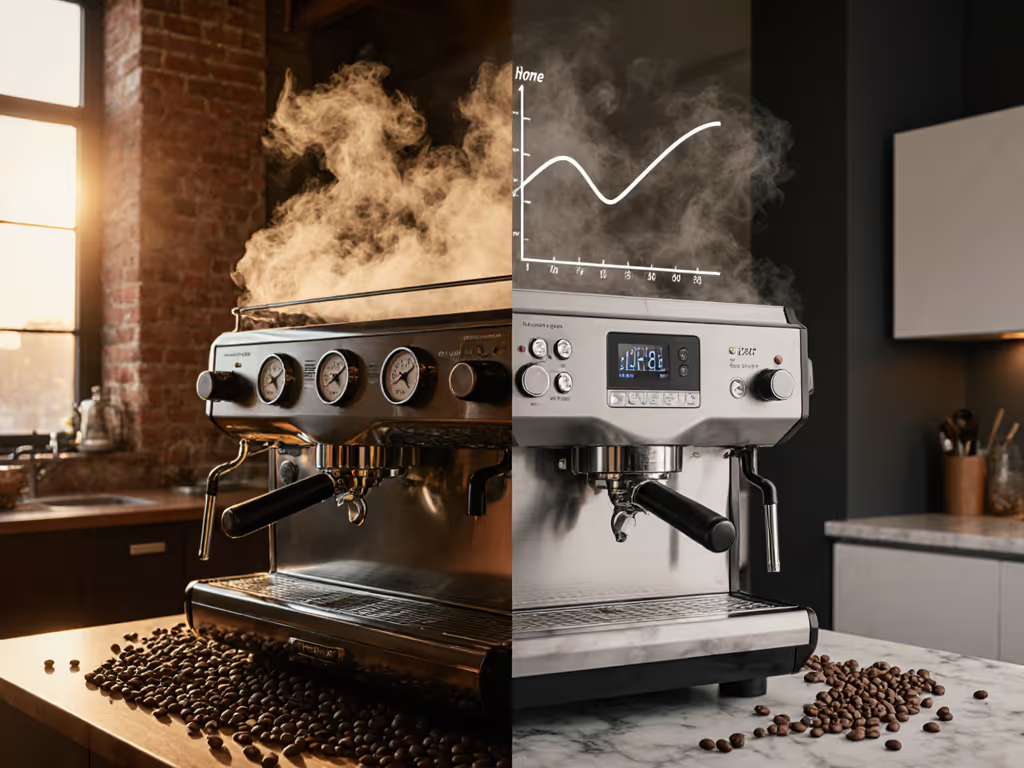
Pressure profiling is the control of pressure applied at different stages of espresso extraction, varying between 0 and 9 bar either statically or progressively throughout the shot. For decades, this capability existed almost exclusively in commercial machines. Today, it shapes how home enthusiasts achieve weekday-proof espresso, the reliable, repeatable cup that greets you Monday through Friday without requiring weekend-level tinkering.
The distinction matters because pressure profiling directly addresses a core challenge in home espresso: channeling, fines migration, and over-extraction during the final stages. Once you understand where this technique originated and how it evolved, you grasp why certain modern machines hold pressure steady while others pivot their curves mid-shot.
Where Did Commercial Pressure Profiling Begin?
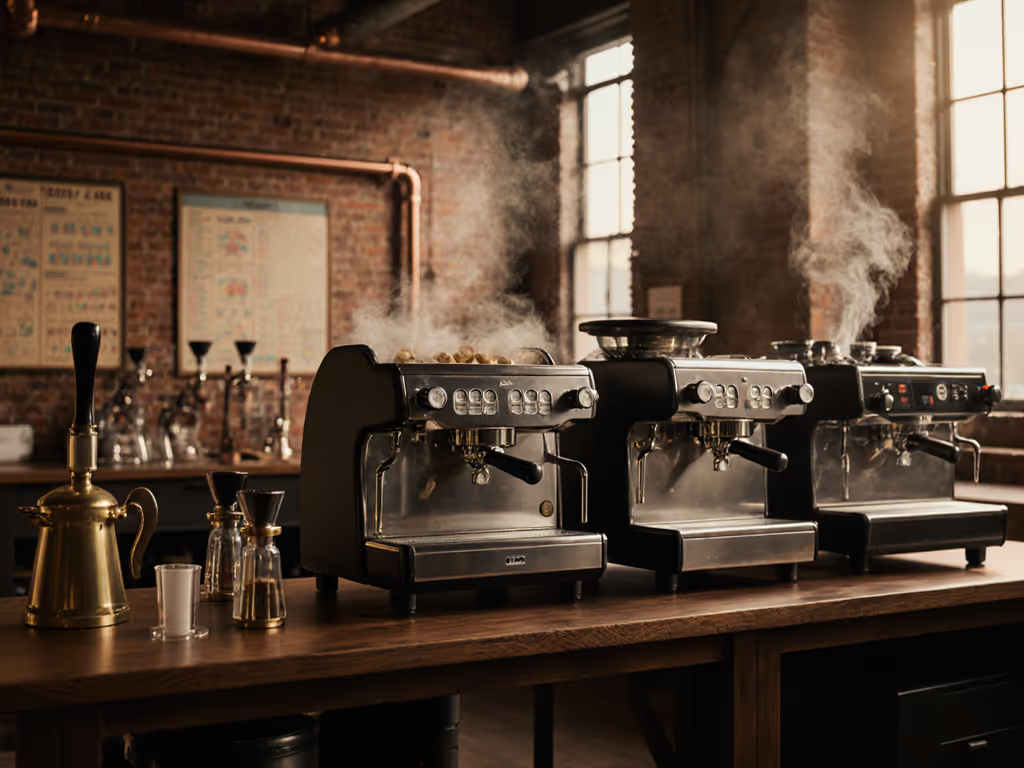
Lever machines arrived first, though not by deliberate design. The manual lever, initially a simple mechanical interface, inadvertently created a natural pressure curve: low pressure during the initial lever pull, rising pressure as a spring forced the lever back to position, and declining pressure afterward. This accidental profile proved effective at preventing channeling, but it demanded manual consistency that no home operator could sustain across five morning shots.
Modern commercial pressure profiling origins trace to machines like La Marzocco's Strada and Synesso MVP Hydra, which replaced mechanical springs with solenoid-controlled pumps and programmable logic. For a deep dive into a modern profiling platform, see our La Marzocco Strada EP review. By the early 2000s, café operators could pre-program pressure curves: a long pre-infusion phase (1-4 bar), a ramp to full pressure (8-10 bar), then a controlled decline in the final third, and repeat that exact profile across hundreds of shots daily. One profile became standard practice, and this three-stage approach now dominates professional environments.
The payoff was immediate: improved consistency, enhanced flavor complexity, and measurable reduction in waste. Coffee researchers observed that pressure-profiled shots produced more pronounced sweetness and acidity compared to constant 9 bar extraction, a finding echoed by comparisons of flat pressure profiles to gradual ramp-ups and ramp-downs.
How Did Pressure Profiling Technology Transition to Home Machines?
The shift from café-exclusive to home-accessible happened in stages:
Early Adoption (2010s): Decent Espresso pioneered the first home-oriented, pressure-profiling machine by embedding dynamic pump control and real-time visual feedback into an affordable ($3k-$4k) platform. This democratized access to programmable extraction curves but required technical comfort and experimentation.
Integration & Standardization (2015–2020): Machines like the Rancilio Silvia and others began offering simpler, pre-programmed pressure profiles (not full real-time control, but preset curves optimized for different roasts). This reduced the cognitive load: you selected a profile rather than designing one from scratch.
Current Availability: Today, pressure profiling capabilities span entry-level semi-automatics ($600-$1500) and prosumer machines ($1500-$3500+), though the feature often requires reading documentation and minor configuration rather than deep technical intervention.
What Pressure Profiling Techniques Define Home Use Today?
Modern home pressure profiling relies on a smaller, more practical toolkit than commercial environments: If you want a practical walkthrough, start with Fix Inconsistent Espresso With Pressure Profiling.
Pre-Infusion Pressure (1-4 bar, 5-15 seconds): Low-pressure saturation of grounds prevents channeling and reduces fines migration to the basket bottom. This stage is the most common adjustment home users make, often the only one required for daily consistency.
Full Pressure Ramp-Up (gradual climb to 8-10 bar): A slower ramp than traditional fixed-pressure machines extracts soluble compounds (acids, oils, sugars) without overwhelming the puck and causing uneven flow.
Pressure Ramp-Down (gradual decline in the final 20-30% of extraction): Reduces extraction of bitter compounds that tend to emerge later, leading to a smoother finish and reduced astringency. This stage directly addresses the weekend-to-midweek taste drift I documented during month-long 6 a.m. testing. One machine with stable PID control and responsive pressure curves held shot temperature and flavor consistency through Thursday; the other, without ramp-down logic, produced bright, clean shots Saturday but increasingly dull, bitter extractions by Wednesday. For complementary control on the temperature side, see Temperature Profiling for Reliable Shots.
Consistency beats charisma when the alarm is barely past snooze.
Why Don't All Home Machines Offer Pressure Profiling?
Three practical barriers remain:
Cost: Solenoid-controlled pumps, microcontrollers, and firmware validation add $300-$800 to machine retail price. At $500-$700 price points, that represents a 40-100% increase, pushing machines into prosumer territory. To understand how pump choice impacts stability and noise, read Rotary vs Vibratory Pumps.
Complexity Tolerance: Many home users prioritize simplicity over control. A fixed 9 bar machine is predictable and requires no decisions; pressure profiling introduces 3-5 adjustable parameters that novices may find intimidating.
Proven Sufficiency: A well-tuned fixed-pressure machine with quality grind consistency can produce café-standard shots, eliminating the technical advantage of profiling for casual users. The return on complexity investment is highest for prosumers pulling 5+ drinks daily or experimenting with single-origin beans.
How Does Pressure Profiling Solve Real Home Espresso Problems?
For optimization-minded weekday users, pressure profiling directly addresses three pain points:
Inconsistent Extraction: Fixed pre-infusion ensures uniform ground saturation, reducing the variance caused by uneven tamping or seasonal grind adjustments.
Dial-In Friction: Once a pressure profile is dialed for a particular coffee, it can be repeated precisely across multiple shots, reducing the experimenting and adjustment time. This is critical in shared kitchens or tight morning windows.
Flavor Drift Across Drinks: Ramp-down profiles protect later shots from over-extraction, maintaining taste balance through a three-drink sequence without re-dialing. This was not possible with traditional 9 bar machines.
What Are the Trade-Offs of Home Pressure Profiling?
Limited Flexibility: Preset profiles work well for one roast style; switching from light single-origin to dark espresso blend may require manual adjustment, adding friction rather than reducing it.
Maintenance Complexity: Solenoid pumps and microcontroller logic require occasional calibration and introduce additional failure points compared to fixed-pressure piston or vibratory pumps.
Diminishing Returns on Budget: Below $1200, the taste improvement from pressure profiling is modest compared to investing in a high-quality grinder or better water treatment. The feature is highest-value for machines $1200+.
Why Is Shot-to-Shot Variance Still Central to the Pressure Profiling Story?
Pressure profiling does not eliminate variance, it constrains it within measurable bounds. During my month of early-morning logging with temperature probes and pressure transducers, the machine with stable PID and responsive pump showed shot-to-shot variance of +/-3°C and +/-0.2 bar across pre-infusion; the competitor without active pressure control drifted +/-5 to 7°C between the third and fifth shot. Both machines produced acceptable espresso in isolation; over a week, the variance compounded into noticeably inconsistent body and finish.
This is the hidden insight: pressure profiling's value is not novelty or complexity. It is the same advantage commercial cafés gained: predictability. When consistency is baked into the machine's firmware and pump response, your weekday routine stops requiring cognitive load and starts requiring only attention.
FAQ: Key Questions About Pressure Profiling for Home Use
Q: Is pressure profiling worth the cost premium for a first home espresso machine?
A: No, unless you're already comfortable with grind dialing and espresso fundamentals. First-time buyers ($400-$900 budget) benefit more from investing in grinder quality and learning basic 9 bar extraction. Learn the core variables in our step-by-step espresso dialing-in guide. Pressure profiling is highest-value at $1500+ when paired with mid-range espresso skill.
Q: Can I retrofit pressure profiling onto my existing machine?
A: Not without full pump replacement, PLC installation, and testing. Most home machines are not designed for retrofit pressure control. This is why pressure profiling adoption is machine-specific rather than universal.
Q: Do I need to reprogram profiles for each coffee roast?
A: Ideally, yes. A pre-infusion suitable for light roasts (5 bar, 10 seconds) may under-extract a dark roast's softer grounds. Programmable profiles allow storage of 5-10 curves, so switching is menu-driven, not mechanical.
Q: How much does pressure profiling reduce bitterness compared to fixed 9 bar?
A: Tests show ramp-down profiles reduce bitter-compound extraction by 10-20%, with the strongest effect in the final 15-20 seconds of extraction. The perceptual difference is moderate, noticeable across multiple shots but not revolutionary in a single cup.
Summary and Final Verdict
Espresso pressure profiling history reveals that this is not a trendy innovation, it is the natural evolution of precision pump control migrating downmarket from cafés to homes. The technique solves real consistency problems; the constraint is cost and complexity, not efficacy.
For your weekday routine, pressure profiling is worth considering if:
- You brew 4+ drinks daily and value repeatable flavor more than tinkering range.
- Your budget exceeds $1500 and you're willing to store 3-5 programmable profiles.
- Your grinder and water treatment are already dialed, so extraction is your remaining variance source.
- You want shot-to-shot stability to hold through Wednesday and Thursday without re-dialing.
If you're choosing between pressure profiling and a premium grinder or water filter at equal cost, the grinder returns higher consistency gains. Pressure profiling amplifies what a good grinder enables; it does not substitute for it.
The lesson from commercial adoption holds: consistency beats charisma when the alarm is barely past snooze. Pressure profiling delivers that consistency at home, provided you invest in the platform that supports it.
Related Articles