Maillard Reaction in Espresso: Consistent Shots Explained
By Maya Desai • 2nd May
Introduction
The Maillard reaction in espresso is a chemical dance between amino acids and reducing sugars that determines whether your Monday shot tastes like your Friday one. This reaction (triggered primarily during roasting but continuing during extraction) is responsible for creating hundreds of flavor and aroma compounds that shape what reaches your palate.[2] But here's the critical insight for home baristas seeking predictable results: the same reaction that produces delicious chocolate and caramel notes is also the reason your 6 a.m. pull tastes nothing like your afternoon backup. The espresso flavor chemistry underlying consistency isn't mystical; it is measurable, controllable, and directly tied to the thermal and pressure profiles your machine delivers. This guide walks through the science and practical metrics that matter when you're pulling shots in a narrow morning window.
FAQ: Maillard Reaction and Espresso Consistency
What exactly is the Maillard reaction, and why should espresso makers care?
The Maillard reaction is a chemical process that occurs when reducing sugars and amino acids (both present in roasted coffee beans) are exposed to heat and moisture. At the atomic level, the carbonyl group (C=O) of a sugar reacts with the amino group (-NH2) of an amino acid, forming an unstable intermediate called a glycosylamine.[1] This compound quickly undergoes the Amadori rearrangement, stabilizing into a compound that serves as a launching point for hundreds of different chemical pathways.[3]
Why espresso makers should care: melanoidins, the high-molecular-weight brown polymers created during these reactions, contribute not just to the brown color of your espresso but also to body, mouthfeel, and the dominant flavors: roasted, nutty, caramelly, chocolatey, and malty.[2][5] Melanoidins also stabilize crema's foam structure.[1] In short, Maillard products define whether your espresso tastes thin, grassy, and flat or rich, complex, and cafe-quality.
How does temperature control affect the Maillard reaction during extraction?
Temperature is the primary lever controlling reaction rate. The Maillard reaction begins at approximately 150°C (300°F) in roasting; during espresso extraction, water temperature typically sits at 88-92°C (190-198°F), considerably lower yet still active.[3] Here's the metric-first insight: a higher rate of heat application increases the reaction rate, and longer reaction time at a given temperature produces a greater number of byproducts, higher complexity, and higher body.[2]
For home machines, this translates into two competing demands:
- Thermal stability: Water temperature must remain within ±2-3°C across pre-infusion, ramp, and main extraction phases. Drift of 5°C or more shifts the flavor profile noticeably toward thin or bitter.
- Consistent pump pressure: Stable pressure (measured in bar) ensures even water flow through the puck, so all grounds extract at similar rates and temperatures.
Many home machines without PID (Proportional-Integral-Derivative) controllers show 3-5°C swings and pressure drift during steam recovery. During one month of 6 a.m. logging on two nominally similar machines, one held a 0.7°C standard deviation across shots; the other drifted 3-4°C between the first and third pull. If your machine supports PID control, explore temperature profiling to fine-tune flavor without sacrificing consistency. Consistency beats charisma when the alarm is barely past snooze, and that's exactly when one machine kept delivering cafe-quality shots while the other left me chasing the grind dial every other day.
Why do espresso shots taste inconsistent day-to-day if I use the same beans and settings?
Shot-to-shot variance in home espresso stems from three linked variables: water temperature, pump pressure, and puck preparation. Each affects the rate and pathway of Maillard chemistry inside the puck.
When temperature oscillates, the fragmentation of Amadori products shifts. Cooler shots underdevelop certain flavor pathways; hotter shots over-develop others, pushing toward bitter or burned notes instead of balanced caramel and chocolate.[5] Pressure variations change water saturation profiles inside the puck, creating local zones of under- or over-extraction. Under-extracted zones don't develop full melanoidin complexity; over-extracted zones generate the reactive intermediates and Strecker aldehydes that produce thin, astringent flavors.[5]
Puck prep inconsistency compounds the problem: uneven tamping or channeling means some grounds sit in different extraction environments, so their Maillard products don't align. Over a week, if your morning routine varies (rushed on Tuesday, meticulous on Saturday), the ensemble of small shifts adds up, and you notice the taste drifting without knowing why.
What role does extraction time play in Maillard chemistry?
Extraction time (typically 25-30 seconds for standard espresso) controls how long hot water interacts with coffee solids. Longer reaction time at a stable temperature produces a greater number of byproducts, higher complexity, and higher body.[2] However, extraction time is not independent; it emerges from the interplay of temperature and pressure.
If your machine delivers 9 bar at 90°C for 27 seconds, you get a certain ensemble of melanoidins and other Maillard products. If pressure drops to 7 bar midway through (common in non-PID machines), the extraction rate slows, and if temperature also dips, reaction pathways change. The shot may taste watery or grassy because the rate and completeness of Maillard chemistry diverged from your baseline.
For taste consistency over time, treat extraction time as a dependent variable: dial in grind and distribution so stable temperature and pressure naturally deliver 27-29 seconds. Don't chase extraction time by altering pressure or temperature on the fly.
Can home espresso machines maintain the thermal and chemical stability needed for consistent Maillard development?
Yes, but it depends on machine architecture. Machines with stable PID temperature control, low thermal mass in the group head, and responsive pumps can hold water temperature within ±1°C and pressure within ±0.3 bar, creating conditions for repeatable shot flavor.
Lower-cost machines (pump-driven with no temperature control) or thermoblock designs with poor heat retention show 3-5°C swings and pressure drift during steam recovery. Over a week of daily pulling, these machines deliver inconsistent melanoidin profiles. Some shots nail the roasted-caramel window; others miss and taste thin or acrid.
Mid-range and prosumer machines with proven PID tuning or dual-boiler setups can achieve ±1-2°C stability, enough for reproducible espresso. The key: choosing machines with transparent thermal specs and real-world testing data, not marketing claims alone.
Practical Takeaway: What You Control
The espresso caramelization process (the visible browning and flavor build) is directly downstream of temperature, pressure, and time stability. You cannot see Maillard chemistry, but you can taste its consistency. To ensure repeatable, complex espresso:
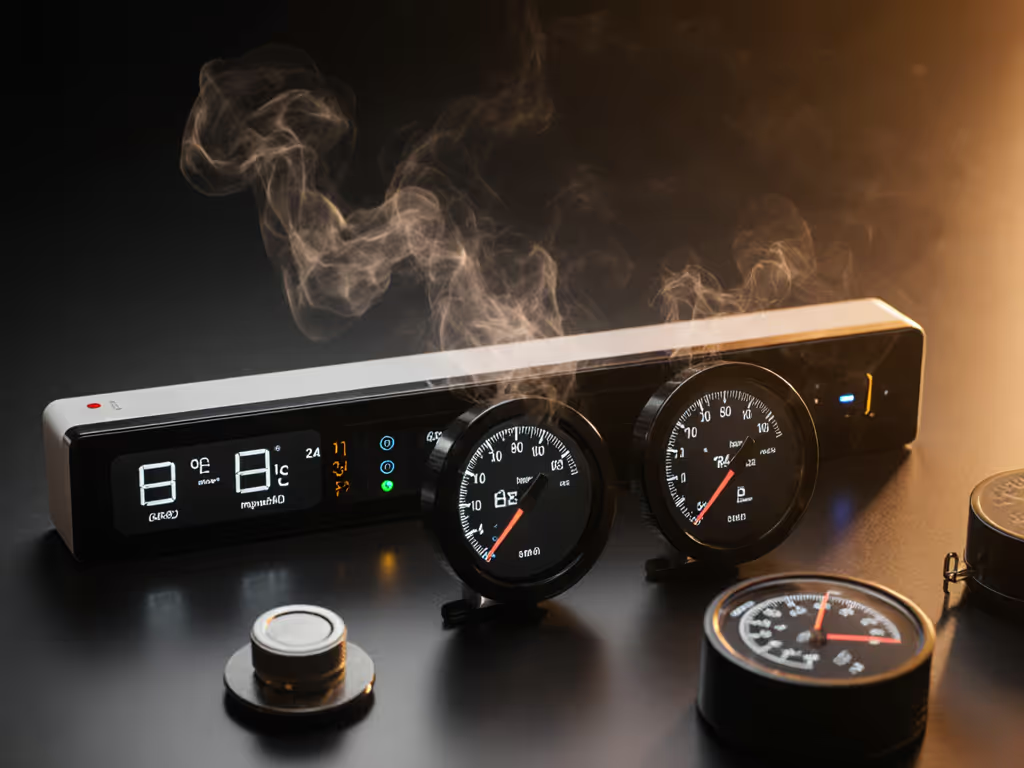
- Monitor machine temperature using external thermometry during your first week; identify drift patterns.
- Use fresh water at each prep session; water temperature is your baseline.
- Standardize tamping pressure with a calibrated tamper or consistent hand technique.
- Log one week of shots: note grind setting, extraction time, flavor notes, and any machine observations. This single week often reveals whether your machine drifts or holds steady.
- Choose machines with published PID specs or proven user communities reporting consistency.
Consistency beats charisma when the alarm is barely past snooze, and that's when your machine's thermal stability matters most.
Final Verdict
The Maillard reaction is not an abstract chemistry concept; it is the engine of espresso chemical reactions and flavor delivery. Understanding that taste depends on repeatable temperature, pressure, and time conditions empowers you to diagnose why shots taste off and what levers actually control outcome. If you're struggling with bitter or sour shots, start with our espresso troubleshooting guide. Home machines capable of ±1-2°C thermal stability and steady pump pressure deliver predictable melanoidin profiles and taste consistency over time. If your current machine shows wide variance, it's not your fault, it is a thermal stability gap. For your morning routine, where repeatable quality matters far more than novelty, prioritizing machines and techniques that stabilize these variables is the best investment you can make.
Related Articles